Some links on this site may be affiliate links
Hamilton Khaki Murph: A Watch That Measures More Than Time
There is a scene in Interstellar that breaks your heart every time. Cooper is leaving. His daughter Murph refuses to say goodbye. She runs out of the house, furious, desperate - and leaves him her watch as a consolation. The same watch he will give her years later, when time on Earth and on Miller's planet flows differently. When the father will age a few years and the daughter decades.
The watch in Interstellar is not a prop. It is the axis around which the plot turns. It is a promise of return. It is the code that will save humanity. It is proof that love can transcend dimensions that even quantum physics struggles to describe.
That watch is the Hamilton Khaki Murph.
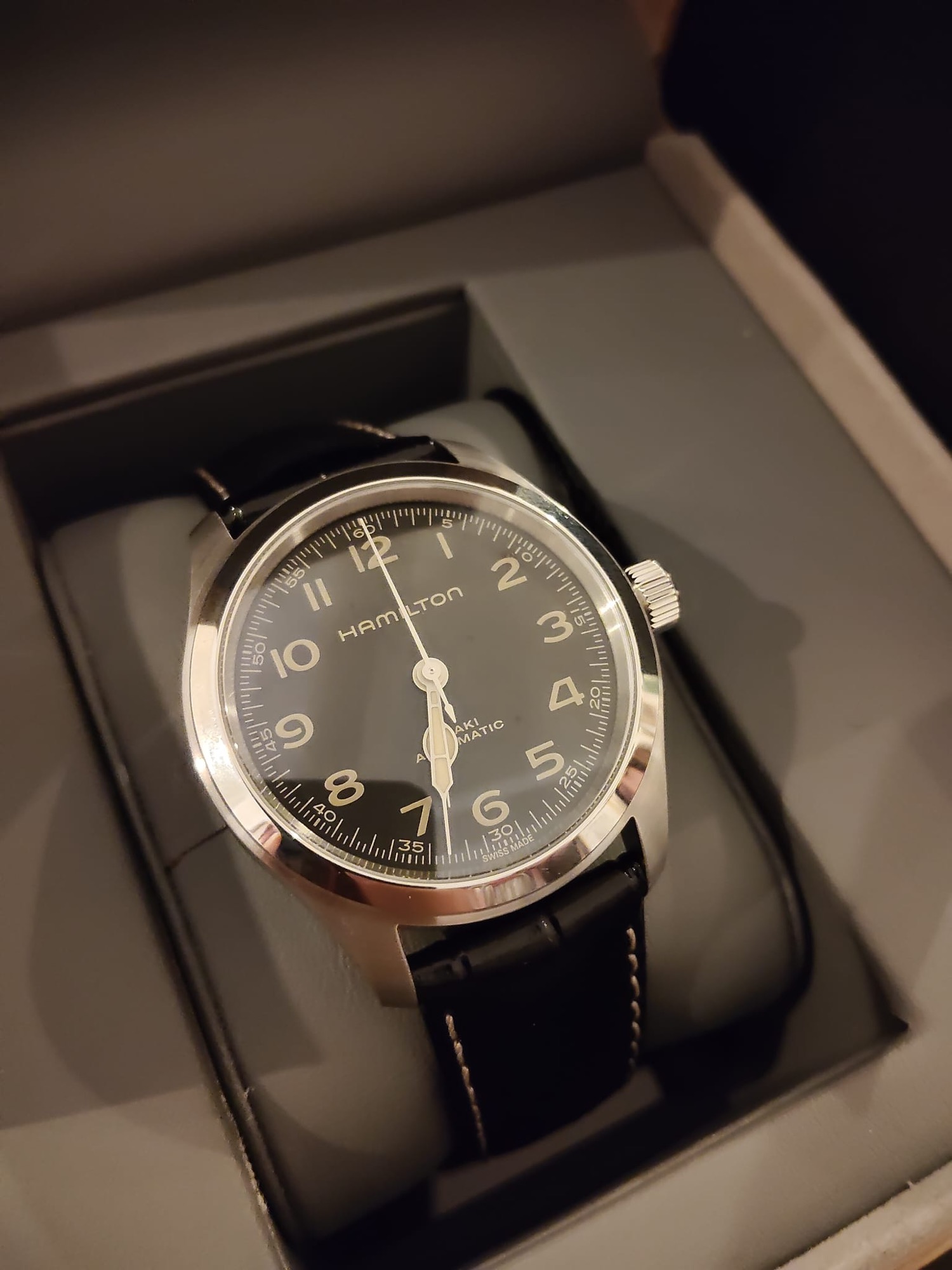
Hamilton Khaki Murph - the watch created for the film Interstellar. 42mm case, H-10 automatic mechanical movement. Photo by Mr. 4645, CC BY-SA 4.0. Source

The watch that plays a role
Hamilton has worked with Hollywood for decades. Their watches have appeared in over 500 films, from Hitchcock's Strangers on a Train to Ocean's Eleven and The Martian. But the role in Christopher Nolan's Interstellar is unique - not because the watch is visible, but because it is crucial to the plot.
The Hamilton Khaki Murph was designed specifically for the film. Its name comes from the character Murphy Cooper - the protagonist's daughter. The characteristic "Eureka" inscription on the seconds hand - which Murph says when she reads the message from inside the black hole - is a detail only the initiated notice.
The watch went on sale only after the film's premiere, in two editions: a limited 2019 version (42mm, automatic H-10) and a newer, smaller version (38mm, also automatic). Both share the same DNA: black case, military style, "Eureka" on the seconds hand. Both are faithful copies of the prop worn by Murph.
Love in the fifth dimension
The plot of Interstellar is based on the concept of time as a physical dimension - not the fourth, but the fifth. In the film, beings from the future (perhaps our descendants) create a five-dimensional space inside the black hole, where Cooper can communicate with the past through... gravity. Specifically: through the hands of a watch.
That scene is one of the most audacious and controversial sequences in cinema history. Nolan says: love is a force that extends beyond the known laws of physics. Cooper does not choose any point in time - he chooses the moment when he holds Murph's hand. Because that is the only moment that matters.
Does quantum physics confirm this vision? Not exactly. But string theory, loop quantum gravity, and models of multidimensional universes allow for the existence of dimensions we cannot directly experience. Time as a dimension in which we can move freely - that is still science fiction. But experiencing time as something that can be bent, stretched, and lost - that is the daily reality of anyone who has ever waited for someone who never returned.
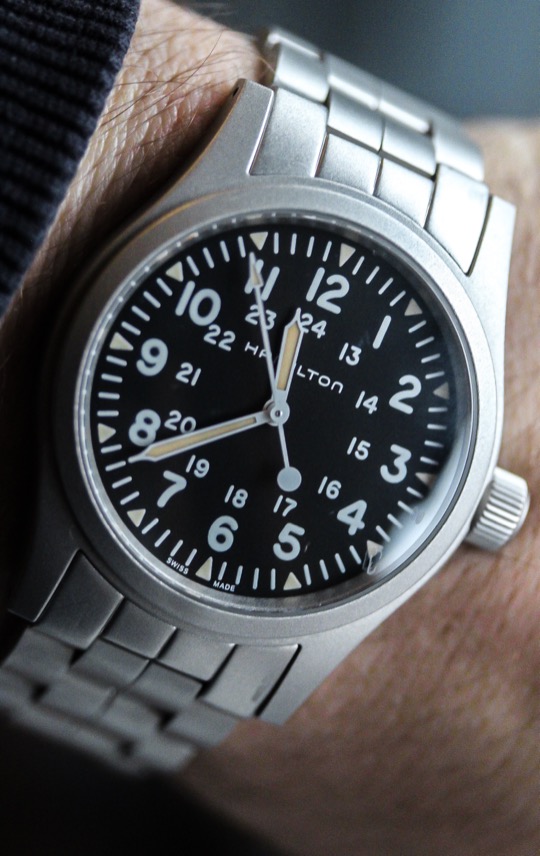
Hamilton Khaki Field Mechanical - the predecessor of the Murph, a mechanical field watch with manual winding. Photo by High Contrast, CC BY-SA 4.0. Source

"Do Not Go Gentle into That Good Night"
Waiting for someone who never returned - in Interstellar this experience takes on a cosmic dimension. Cooper waits to see his grown daughter. Earth waits for salvation. And in this suspension between hope and despair, a poem appears.
In Interstellar, Dylan Thomas's poem appears multiple times. Professor Brand recites it before his death. Murphy quotes it at a critical moment. It is the film's leitmotif - a cry not to surrender to the darkness, to fight to the end.
Do not go gentle into that good night, Old age should burn and rave at close of day; Rage, rage against the dying of the light.
Though wise men at their end know dark is right, Because their words had forked no lightning they Do not go gentle into that good night.
Wild men who caught and sang the sun in flight, And learn, too late, they grieved it on its way, Do not go gentle into that good night.
Grave men, near death, who see with blinding sight Blind eyes could blaze like meteors and be gay, Rage, rage against the dying of the light.
And you, my father, there on the sad height, Curse, bless, me now with your fierce tears, I pray. Do not go gentle into that good night. Rage, rage against the dying of the light.
Thomas wrote this poem in 1947, five years before his own death. The addressee was his father, David John Thomas, who was losing his sight and fading into old age. But the poem took on a life of its own - it became a universal appeal against resignation, against leaving without a fight.
Dylan Thomas died in 1953 in New York, at the age of 39. Official cause: pneumonia. Unofficial: the alcohol that had been destroying and driving him all his life. His last words were reportedly: "I've crossed the other side" - after drinking eighteen glasses of whiskey in a hospital emergency room. Did he know he was crossing to the other side? Did he believe we can break free from the chains of time?
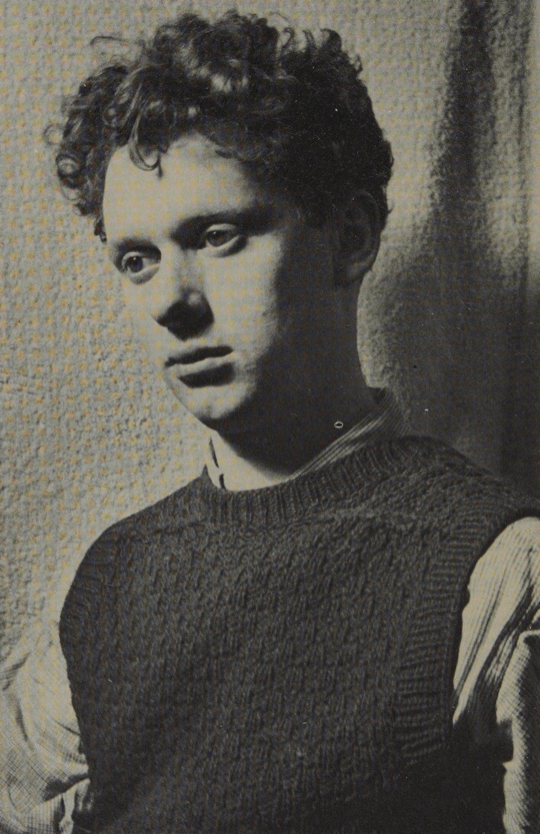
Portrait of Dylan Thomas (1914-1953) by Nora Summers. Welsh poet, author of Do Not Go Gentle into That Good Night. Public domain. Source

Time that bends and breaks
The most beautiful thing about the concept of time in Interstellar is that it is not pure fantasy. When the astronauts land on Miller's planet, right next to the black hole Gargantua, time passes sixty thousand times faster for them than on Earth. An hour on the planet is seven years at home.
This is not a screenwriter's invention. It is time dilation predicted by Einstein's general theory of relativity. The stronger the gravitational field, the slower time flows. On Earth's surface, time flows slower than in orbit - GPS must account for this difference to function correctly.
If we could send someone into orbit around a black hole, that person would age so slowly that for the rest of the world they would become immortal - until they returned to our time zone and the lost years caught up with them. Interstellar shows this in a devastating way. Cooper returns to Earth after years that were weeks for him. His daughter is an old woman. She runs NASA. She saved humanity. And he was not there to help her. Time was not on his side.
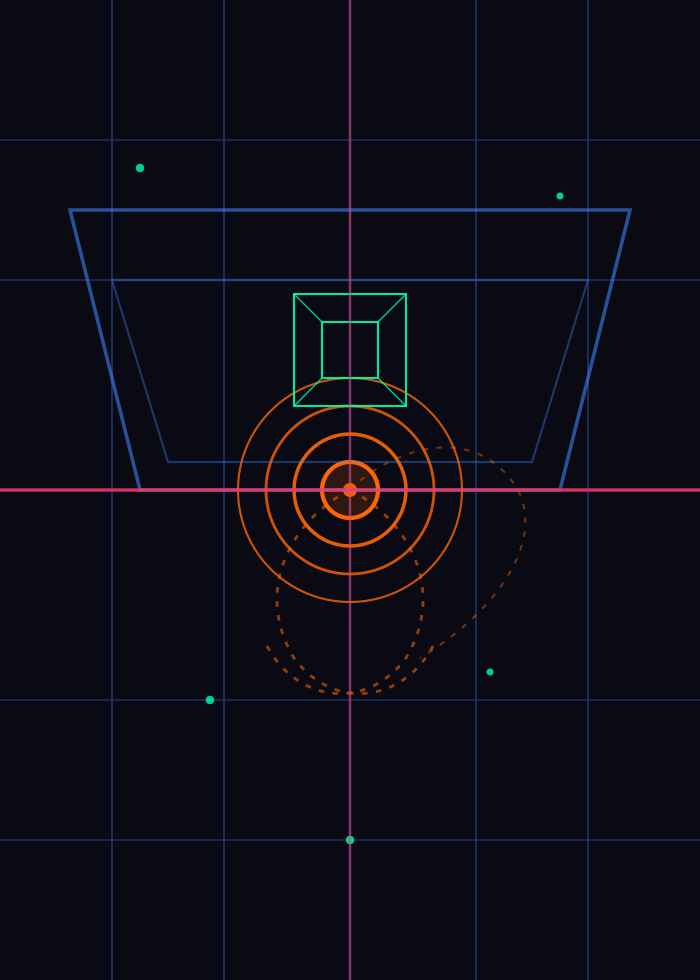
Visualization of spacetime distortion in the film Interstellar – a tesseract enabling communication across dimensions. Author: Mariusz Nawrocki, CC BY-ND 4.0.
Spotify and the poem on loop
There is one more detail connecting Interstellar with Thomas's poem that few people know about. On Spotify, there is the official film soundtrack by Hans Zimmer. But there is also a separate track - Do Not Go Gentle into That Good Night - a recitation of Thomas's poem with a musical backing that appears in the film and on the Interstellar: Original Motion Picture Soundtrack album.
It is a rare case where poetry is woven into a blockbuster's soundtrack so organically that it becomes inseparable from its emotional landscape. When Murphy recites "Do not go gentle into that good night" at the moment she reads the message from beyond the event horizon, the poem ceases to be just a poem. It becomes an instruction: do not go gently, fight, find the answer.
Zimmer's entire Interstellar score is built on organ and piano - simple, almost ascetic sounds that convey the vastness of space and human helplessness before time. There is no symphonic pomp usually heard in science fiction films. Instead, there is silence. And the ticking of a clock.
Into the black hole of timeless connections
The finale of Interstellar leaves more questions than answers. Cooper falls into the black hole. He enters a five-dimensional space where time is a physical surface. He sees Murph in the past. And he decides not to change history - only to fulfill it.
The Hamilton Khaki Murph on his wrist at the moment of the jump becomes more than a watch. It becomes a tool of communication with what was. It becomes a bridge between dimensions. It becomes proof that even in a world where time can be bent, stretched, and transcended, one thing remains unchanged: the love between people who do not give up.
And perhaps that is why this watch has such power. Not because it is beautiful - though it is. Not because it is precise - though Hamilton is known for precision. But because it reminds us of something we too often lose sight of in our pursuit of the future: that time is not meant to be measured. It is meant to be lived.
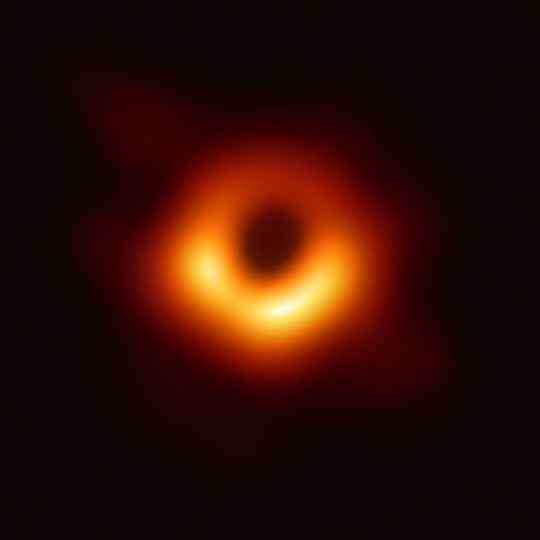
The black hole at the center of galaxy Messier 87 - the first direct image of a black hole in history. Inside it, according to Interstellar, time becomes space. Public domain (Event Horizon Telescope). Source

Time is not numbers
Mechanical watches are an anachronism today. A smartphone measures time more accurately. The atomic clock NIST-F2 in Colorado is so precise it would lose a second only after 300 million years. A mechanical Hamilton with the H-10 automatic movement - with an 80-hour power reserve - is next to it like an hourglass next to an Olympic stopwatch.
Yet people still wear mechanical watches. Why?
Because time is not a measurement. Time is an experience. A mechanical watch does not so much measure it as represent it - its cyclicity, its passage, its irreversibility. The mainspring slowly unwinding, the balance wheel oscillating back and forth at four hertz - this is mechanical poetry that a smartphone can never convey.
The Hamilton Khaki Murph is the best example of this. It is not expensive like a Rolex nor exclusive like a Patek Philippe. It is a simple field watch, solid, unpretentious, costing what an honest mechanical watch should cost. And there is something in it that cannot be measured: a story.
Everyone who wears it also carries the story of Cooper and Murph. The story of a poem that commands us to fight. The story of time relativity and a love that transcends it. And perhaps that is why this watch has become so iconic - not through marketing, not through celebrities, but because it tells a story that resonates with anyone who has ever feared losing someone close.
Do not go gentle
Dylan Thomas died in 1953. Christopher Nolan made Interstellar in 2014. Hamilton released the Khaki Murph in 2019. Three different moments in time, three different stories that intertwined into a single object.
And that is the magic of objects. They are not dead. They carry within them the memories, meanings, and emotions of their creators and users. The watch Murph received from her father does not measure time on Miller's planet - it measures a love that cannot be measured in any unit.
And perhaps that is why when Murphy finally reads the message, she looks not at the numbers, but at the hands. Because time does not fit into numbers. Time fits between them.
Rage, rage against the dying of the light.
Further reading
- Hamilton Watch on Wikipedia - brand history
- Interstellar on IMDb - film
- Dylan Thomas official site - biography and works
- Wikipedia: Time dilation - relativity physics
- NASA: Black Holes - black holes
- Mechanical watches on Amazon - Hamilton Khaki Murph
Co-created by human and AI.