Some links on this site may be affiliate links
Citizen Eco-Drive: Light That Walks
Every watch I owned before this one wanted something from me.
A mechanical one had to be wound. Worn daily, it wound itself with the movement of my arm, but two days in a drawer were enough to stop it. A quartz watch carried a battery inside and reminded me about the watchmaker once every two years. That errand always felt like a waiting room: you sat at the counter and waited for someone to open the case. I never liked the arrangement. The thing that was supposed to keep my time demanded keeping.
This one wants nothing.
In Polish a watch does not run. It walks. Which is why the title of this essay is Light That Walks.
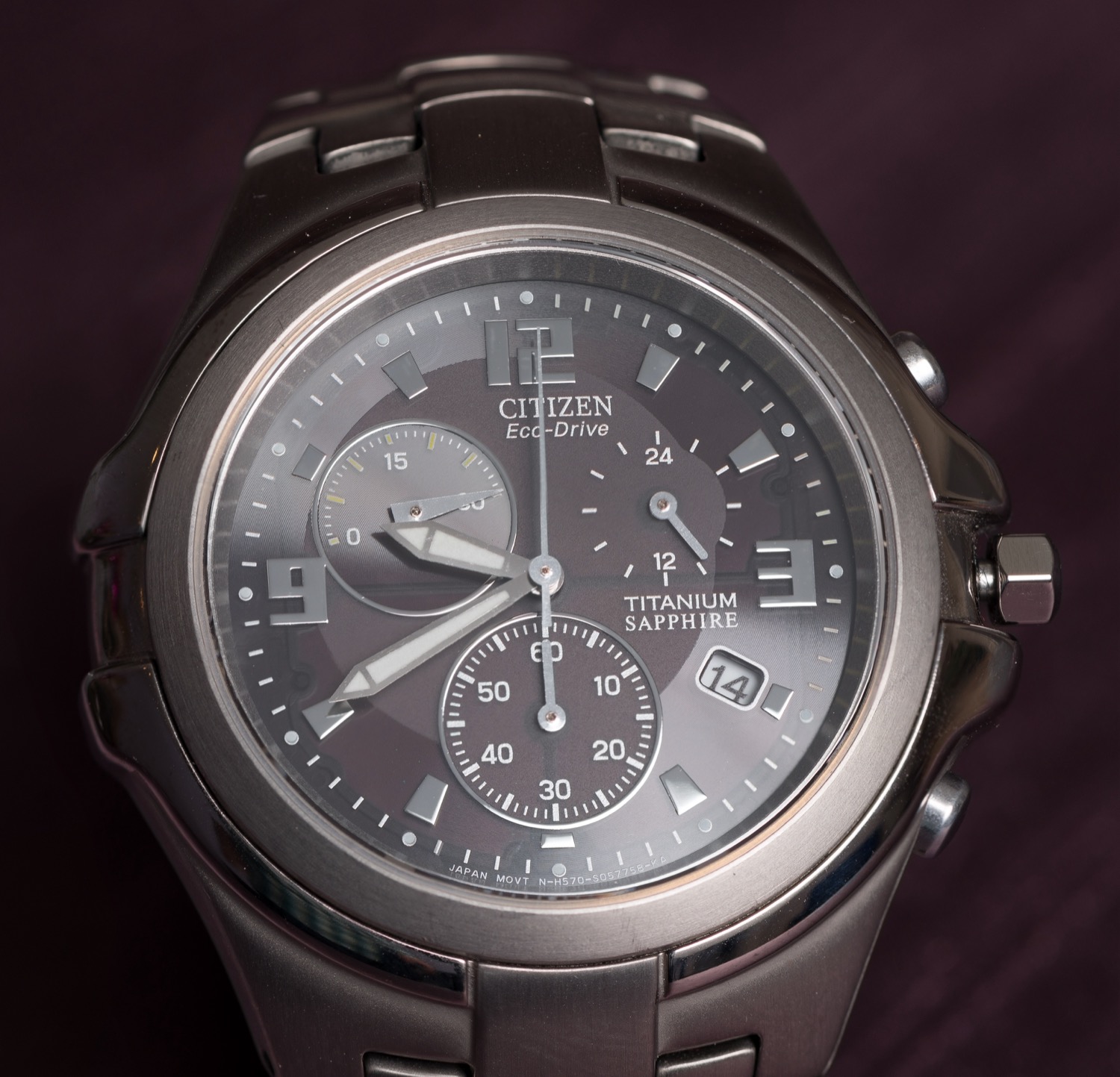
Citizen Eco-Drive Titanium Sapphire, a chronograph in a titanium case. By Tuxyso, CC BY-SA 3.0. Source

Its name was given by a stranger. In 1924 a workshop in Tokyo finished its first pocket watch and showed it to Gotō Shinpei, the man who a year earlier had been in charge of rebuilding the city after the Great Kantō earthquake. Shinpei wanted this watch, then still a luxury item, to reach ordinary people one day.
Almost every watch carries the name of the person who made it, or of the company that sold it. This one was named after whoever wears it. The name is a promise, and it is no surprise that the company still repeats it in a single sentence: loved by citizens, working for citizens.
The idea for the power source came out of a crisis. After the oil shock of 1973 people started talking seriously about other sources of energy, and Citizen asked the question its own way: does a watch really need a battery? In 1976 it released its first analogue watch powered by a solar cell.
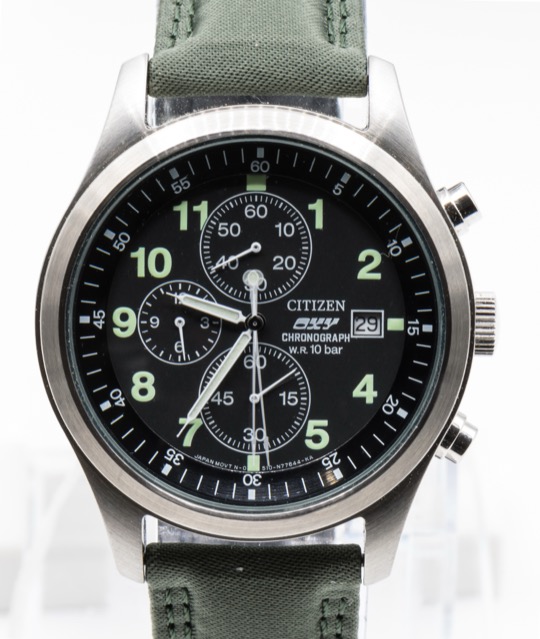
Citizen CTZ-9104, an ordinary quartz chronograph. This one still belongs to the old school: no solar cell at all, and a battery that has to be replaced. By Jacek Halicki, CC BY-SA 4.0. Source

It is worth pausing on what light is as a source of power. A battery has to be bought and then thrown away. Electricity is metered and billed every month. Daylight belongs to nobody, cannot be invoiced, and falls the same way on a watch, on a stone and on the wrist that carries it. Solar power here is not a design feature. It is one line crossed out of a calendar. In 2007 the company estimated that in North America alone ten million batteries were never thrown away because of this technology. In 1996 Eco-Drive became the first Japanese watch to receive the Eco Mark.
The more interesting things, though, happen in the dial. It has to be translucent but not transparent. Citizen explains this without hedging: with an opaque dial the cell gets no light, and with an over-transparent one the cell becomes visible, which does not look good. The whole object rests on a single decision: how much light to let in, and how much to cover up.
A watch is a thing that exists to be looked at. It keeps its most important organ hidden and does everything so that nobody sees it. The materials were searched for over decades: washi paper, mother of pearl, sapphire glass one hundred and fifty micrometres thick, structural inks that change colour depending on the angle you look from. They all share one property. They let something through and hold something back.
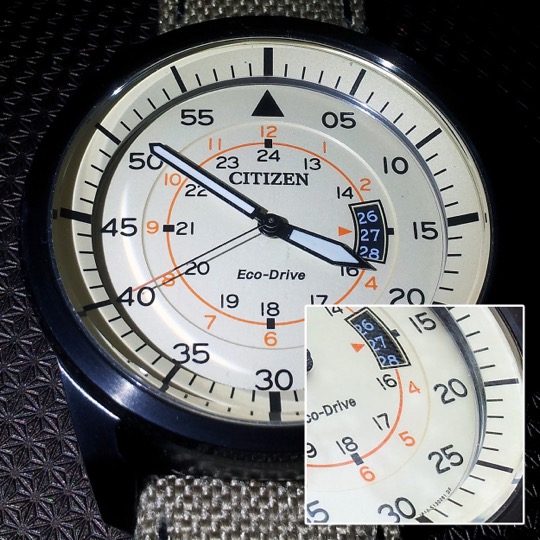
Citizen Eco-Drive METAL dial with the solar ring left visible. By Crētus, CC BY-SA 4.0. Source

Usually it works the other way round. Watching a movement work costs extra, a sapphire caseback is an option you pay for, and watch fairs are arranged so that people can stare at springs and wheels. This watch hides the effort, and that is its rule rather than an exception. A few models let the cell out to the rim of the dial, and only then can it actually be seen.
The second thing you notice after spending time with this object concerns sleep. A watch left in a drawer does not switch off. It falls asleep. The hands stop so that energy is not wasted, while the mechanism keeps counting and knows what time it is. When the light returns, the hands start moving and catch up quickly, as if nothing had happened in the meantime.
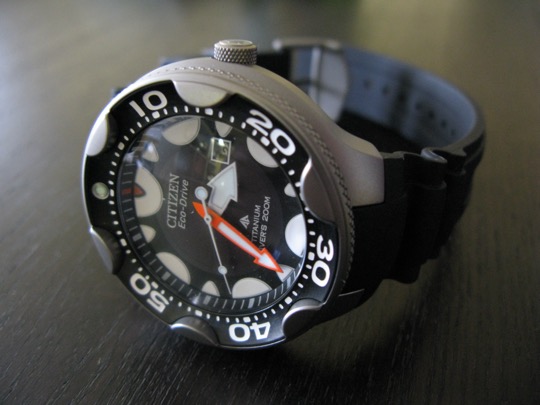
Citizen Promaster Eco-Drive BN0015-07E, a Diver's 200 m in a titanium case. The solar cell sits under the dial, and a fully charged E168 caliber runs for one hundred and eighty days without light. By Guillaume Pillet, CC BY 2.0. Source

I looked up the instructions to find out how much light it needs. Five to six hours of direct sunlight a month. That is all. I cannot give it anything, since I have no say over the weather, but something still has to be done. A curtain has to be opened. Weather forecasts have replaced the watchmaker. I am no longer the mechanic of this watch, I am someone who moves light around. People used to wear a watch to keep time with them. Now you half grow one.
There is one more detail that stopped me from seeing this object as electronics. When the charge runs low, the second hand starts moving in two-second steps. The watch limps. It is a warning sent in the only language it has. The machine asks for help. I wonder how many objects around me do the same, if only I could read their signals.
This power source has removed several things that seemed impossible to remove. There is no battery, so there is no visit to the watchmaker. Models from 2019 are accurate to a second a year, which means there is nothing to correct and nothing to check. A watch from The Citizen line was sold with a ten-year warranty, and some models with a power save function can run seven years on a single charge. All these numbers add up to one message: this object is no longer a task.
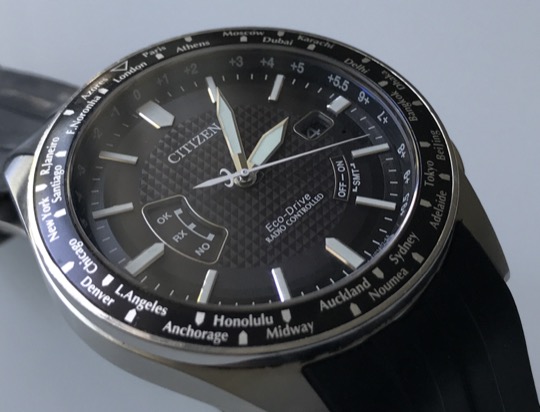
Citizen CB0021-06E with the H144 caliber: Eco-Drive with radio correction and a ring of time-zone cities. This watch checks the time by itself. By Ocrho, CC0 1.0. Source

One thing in all of this is missing, and it is not the batteries. Winding a watch was a small daily act I liked more than I care to admit. You took something in your fingers that is running out, and for a moment you gave it enough strength for the next day. That was not maintenance. It was a short conversation, repeated every morning, with a clear understanding of who was looking after whom.
I do not resent an object that no longer needs this. What interests me is what happens to attention when the occasion to show it disappears. It is easy to like what has to be fed. It is harder to like what can spend a month in a dark drawer without forgetting either the hour or me.
I rarely put it down for more than a couple of hours, though not out of fear that it will stop working. No. There is nothing I have to check, so instead I admire it and watch how patiently it works. I wonder then whether an object that needs nothing from me is still mine. A strange feeling.
Further Reading
- Citizen: Eco-Drive technology - how the power system works, why the dial has to be translucent, and what the watch does in the dark
- Citizen Watch, Wikipedia - the company and the story of its name
- Eco-Drive, Wikipedia - the technology and the estimate of ten million batteries
- Citizen Eco-Drive watches - models currently on sale
Co-created by human and AI.