Some links on this site may be affiliate links
Space Age Design: The Future That Never Came
Space Age Design: The Future That Never Came
In 1958, Brussels opened Expo 58. Its centerpiece was the Atomium - a giant structure depicting an iron crystal magnified 165 billion times. Nine silver spheres connected by tubes, cosmic, as if ripped from the pages of a science fiction novel. The symbol of a new age. The symbol of the Space Age.
What began as a space race between the USA and the USSR quickly permeated every area of life. Architecture, furniture, fashion, household appliances, even photography - everything had to look like the future.
And that future was beautiful.
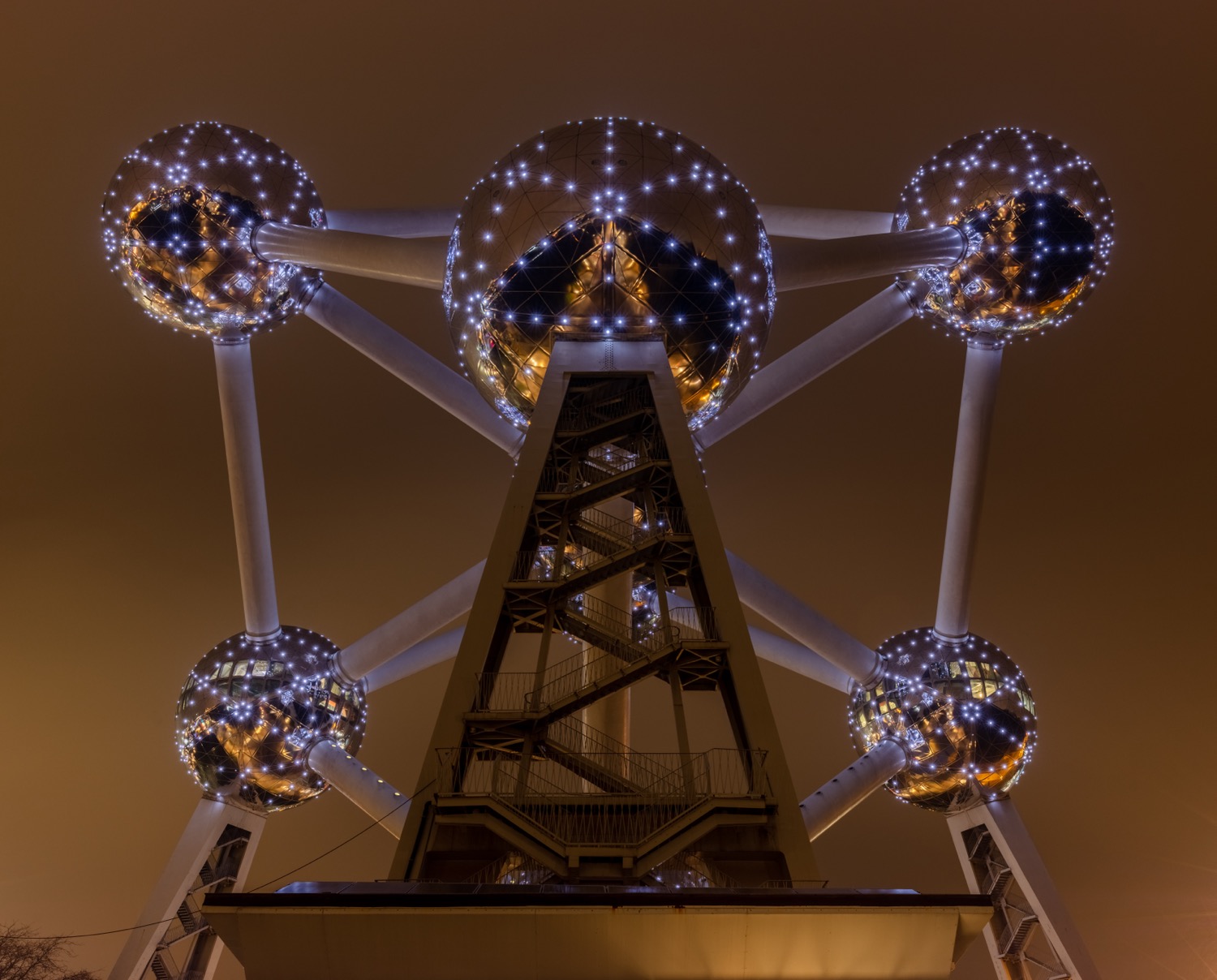
Atomium in Brussels, built for Expo 58. Designed by André Waterkeyn. Photo by Cezary Sułkowski, CC BY-SA 4.0. Source

Sputnik and the birth of a new aesthetic
On October 4, 1957, the Soviet Union launched Sputnik 1. That small, gleaming satellite changed everything - not just politics, but design. Suddenly the future was no longer a distant abstraction. It was right around the corner, metallic, aerodynamic, and luminous.
Designers around the world responded immediately. Forms became organic, streamlined, inspired by rockets, capsules, and spacesuits. Colors became vivid: orange, pink, silver, white. Materials became new: plastic, fiberglass, acrylic, chrome steel. Furniture stopped being furniture. It became a vehicle for a journey into the future.
Eero Aarnio, the Finnish designer, created the Ball Chair in 1963 - a sphere on a stand that looked like a space capsule. You climbed into it, closed yourself off, and cut yourself from the world. It was not furniture. It was a spaceship for the mind.
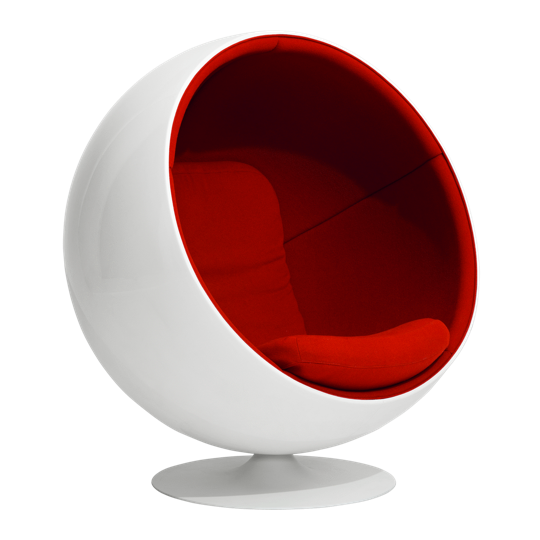
Ball Chair (1963) by Eero Aarnio - an icon of Space Age design. Photo by Ludovic Péron, CC BY-SA 4.0. Source

Panton and the plastic revolution
If one designer best embodies the spirit of the Space Age, it is Verner Panton. A Dane who rejected Scandinavian wood and natural materials in favor of plastic, steel, and vivid colors. His Panton Chair (1960) was the world's first chair made entirely from a single piece of molded plastic. No legs, no joints, no compromises.
The chair looked like a sculpture - a sinuous, S-curved form in a bold color. It could be mass-produced cheaply and placed in any interior. Panton designed not just furniture but entire environments. His famous Visiona 2 (1970) aboard a floating exhibition ship was a total work of art - walls, ceilings, furniture, carpets - everything undulating, colorful, psychedelic. An interior that looked like the inside of a spaceship designed by Kubrick.
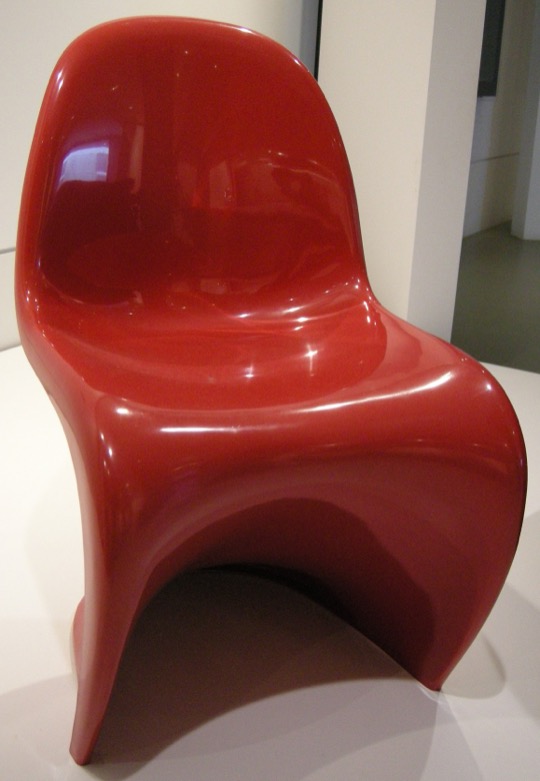
Panton Chair (1960) by Verner Panton - the first single-piece plastic chair. National Gallery of Victoria. Photo by NGV, CC BY 2.5. Source

Panton has often been compared to photographers from the Provoke circle - they too rejected established conventions and sought a new language. But while Moriyama and Tomatsu shattered the image into grain and darkness, Panton shattered space into color and light. Both were moving in the same direction - toward something that had no name yet.
Aarnio: flight in color
After the success of the Ball Chair, Eero Aarnio did not rest on his laurels. In 1967 he designed the Pastil Chair - a lozenge-shaped seat that was even more radical than the Ball. It had no legs, rested directly on the floor, and its user sat inside it as if in a hollow. It was a seat for sitting, lying, rocking. Indefinable, like a life form from another planet.
That same year came the Bubble Chair - a transparent sphere suspended from a chain, floating in the air. Possibly the most photogenic piece of furniture of the twentieth century. Sitting inside it, one felt like an astronaut suspended in a void. Visible from all sides, yet isolated from the world.
Aarnio's chairs were photographed by the greatest interior photographers of the time. Period images show models in futuristic outfits, with elaborate hairstyles, sitting in these chairs as if in capsules. They were not photographs of furniture. They were images of the future.
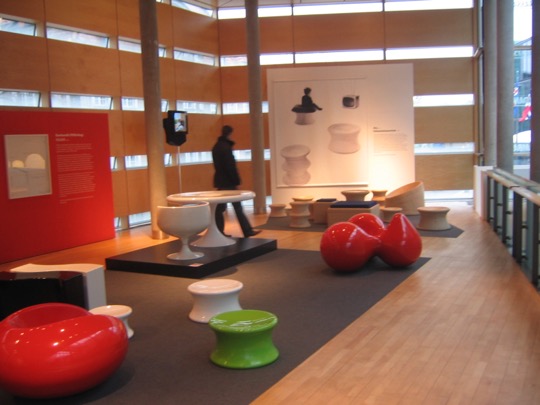
Pastil Chair (1967-68) by Eero Aarnio, at a Berlin retrospective. Photo by Rolf G. W. M. O., CC BY-SA 2.0. Source

Colombo: modular utopia
While Aarnio and Panton designed for the individual, Joe Colombo thought about the whole. His vision was the apartment of the future - modular, flexible, where every element could transform into something else.
Colombo died in 1971 at just 41, but he left behind designs that still astonish with their audacity. His Tube Chair (1969) consisted of four foam cylinders that could be freely configured - as an armchair, chaise lounge, or bed. Furniture was no longer fixed. It was fluid.
Even more radical was the Total Furnishing Unit (1971) - a complete apartment in a single module: bed, desk, wardrobes, lighting. Everything in a few square meters. Colombo designed for a future where space would be expensive and people would live in small, intelligently designed capsules. He was right. Except instead of beautiful, colorful modules, we got IKEA.
Googie: tomorrow's architecture
The Space Age was not limited to furniture. Architecture experienced its own cosmic revolution. Googie - named after a coffee shop in Los Angeles - is concrete, glass, steel, and roofs shaped like flying saucers. Gas stations, motels, restaurants. Ordinary buildings that looked like mission control centers for a Mars expedition.
The style was born in Los Angeles, the city of cars and freeways, where architecture had to grab attention at 80 km/h. Gas stations with boomerang roofs, restaurants like spacecraft, motels with neon arrows pointing to the sky. Googie was kitsch and magnificent at the same time. It was the architecture of optimism, believing the future would be better.
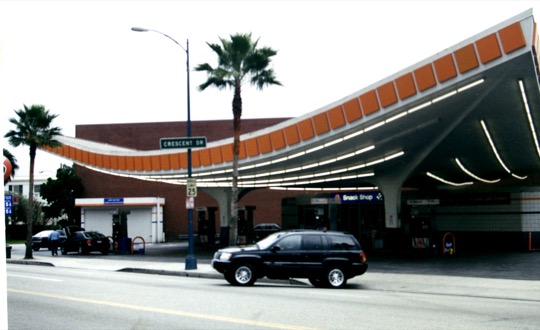
A Googie-style gas station - the architecture of cosmic optimism in the 1950s and 60s. Photo by Welcomia, CC BY-SA 3.0. Source

Small objects, big tomorrow
The Space Age was not only about grand furniture and buildings. It was also about small everyday objects that designers transformed into cosmic artifacts. Lamps, radios, clocks, televisions - everything had to look like it came from the cockpit of a starship.
Iconic desk lamps of the era combined functionality with futuristic design. Adjustable arms, rounded shades, chrome bases - these objects were designed not just to provide light, but to be objects of desire. Their form said: we are from the future.
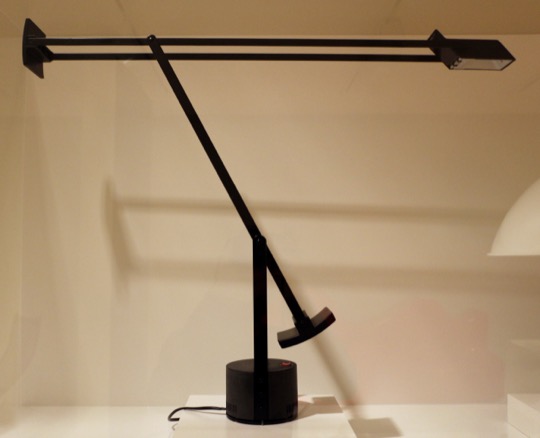
Tizio lamp (1971) by Richard Sapper for Artemide - an icon of space age desk design. Photo by Sailko, CC BY-SA 3.0. Source

Japanese flip-clock radios became one of the most recognizable symbols of the Space Age in everyday life. Models like the Sankyo Dayglo, with their vivid neon colors - orange, yellow, pink - are now cult objects. The Blaupunkt Genua and Welton Space Age 360, with their characteristic rounded shapes and curved displays, are the quintessence of domestic futurism. These objects combined precision mechanics with bold design: plastic casings, bright color accents, shapes inspired by car dashboards and airplane cockpits.
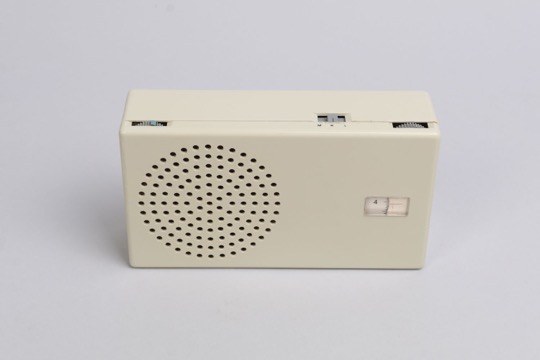
Braun T4 radio (1960) by Dieter Rams - the quintessence of restrained, functional space age design. Photo by Dieter Rams, CC BY-SA 4.0. Source

Televisions followed the same path. In the 1950s they were heavy wooden cabinets; suddenly they became light, mobile, cosmic. The Philips Discoverer is one of the most beautiful examples: a television in a rounded plastic casing that resembled an astronaut's helmet. It opened like the mouth of a spaceship. It was portable, colorful, and looked like a prop from a science fiction film. Today the Discoverer is the holy grail of design collectors.
What unites these objects is one quality: they were not just tools. They were a promise. Everyone who bought a rocket-shaped lamp, a flip-clock radio, or a TV in a cosmic casing was not buying an object, but a piece of the future.
Photography meets the Space Age
The Space Age and photography intersected in many ways. Fashion and interior photographers of the 1960s created images that looked like film stills from science fiction. Models in silver jumpsuits against Aarnio's transparent chairs. Living spaces bathed in Panton's colored light.
But a deeper connection lies in the idea itself. Both photography and Space Age design grappled with the same question: what does a world that does not exist look like? A photographer, taking a picture, freezes time. A Space Age designer, creating furniture, freezes the future. Both acts are acts of imagination - attempts to make the invisible visible.
In the Japanese photography of the 1960s, which I write about on offzine.com, this tension was especially clear. Moriyama photographed the future as spectral, disintegrating into grain. Aarnio designed the future as perfect, smooth, colorful. Two sides of the same coin: belief in the future and doubt about it.
Tulip Chair: the elegance of space flight
Not all Space Age designers worked in plastic and vivid colors. As early as 1956, Eero Saarinen designed the Tulip Chair - a single-stem chair that looked like a flower growing from the floor. Saarinen wanted to eliminate the "slum of legs" - the tangle of four legs under tables and chairs. His solution was radical: a single, slender aluminum base.
The Tulip Chair combined elegance with futurism. It did not shout "I am from the future." It simply was. And it remains as relevant today as the day it was created. Proof that the best design of the future is the one that does not age.
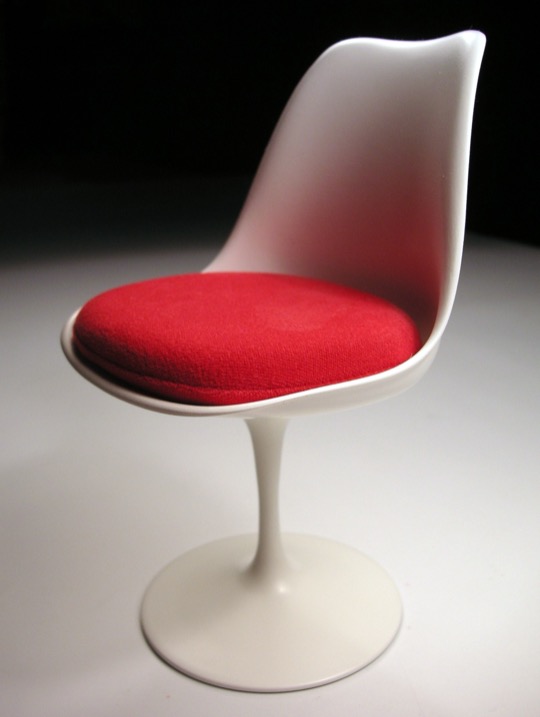
Tulip Chair (1956) by Eero Saarinen for Knoll International. Photo by Frankie Fouganthin, CC BY-SA 3.0. Source

Total interiors: the immersive aesthetic
Panton did not stop at individual furniture pieces. His vision was the total interior - a space where everything is coherent. Walls covered with patterns, furniture integrated into the floor, lighting that changed color. Panton was the first designer to think of interiors as experiences, not just collections of objects.
His late-1960s projects are almost psychedelic. Geometric patterns, rainbow colors, undulating lines, mirrors, and transparencies. These were not interiors to live in. They were interiors to experience. Panton was decades ahead of his time - today his aesthetic lives on in social media feeds, Instagram loops, and vaporwave imagery.
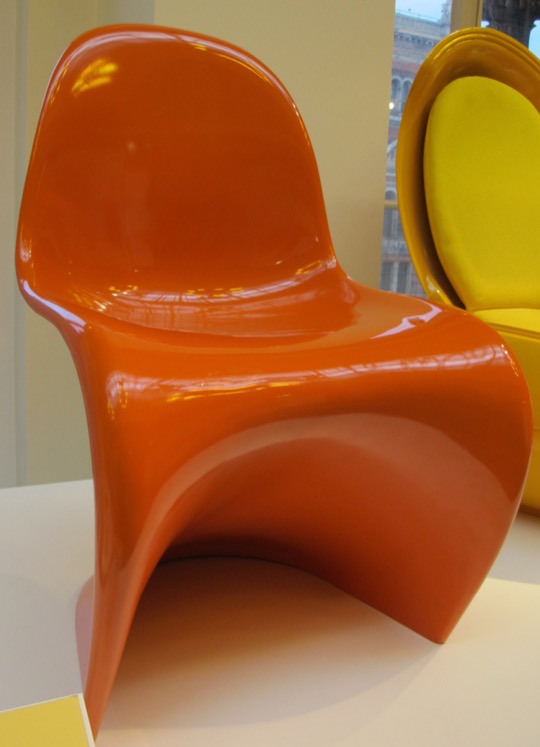
Panton Chair (1960) - side view showing the fluid, sculptural form. Photo by Sailko, CC BY-SA 3.0. Source

Legacy: the future that passed
The Space Age as a movement ended sometime in the mid-1970s. The oil crisis, the end of the space race, fatigue with optimism. Instead of flying cars, we got traffic jams. Instead of cities under domes, we got concrete housing blocks.
But what it left behind is more than museum exhibits. The Space Age shaped our imagination of what the future SHOULD look like. When today's designers talk about futuristic design, they unconsciously reach for forms developed in the 1960s. Every startup designing a "modern" office, every car manufacturer creating a "futuristic" concept, stands on the shoulders of Aarnio, Panton, and Colombo.
And perhaps the greatest legacy of the Space Age is not the furniture or the buildings. It is the longing for a world that could have come but never did. A world where technology served not only efficiency but also joy. Where plastic was a promise, not a threat. Where a chair could be a spaceship and an armchair a time capsule.
The tomorrow that the Space Age promised never arrived. But its beauty still haunts us.
Further reading
- Eero Aarnio official website - portfolio and biography
- MoMA: Joe Colombo - works in the collection
- Vitra Design Museum - one of the world's leading design museums
- The Atlantic: Space Age design - nostalgia for the future - essay
- Verner Panton on Wikipedia - biography and works overview
- Design books on Amazon
Co-created by human and AI.