Some links on this site may be affiliate links
Masahisa Fukase: The Solitude of Ravens
Masahisa Fukase: The Solitude of Ravens
In 2010, The Guardian called The Solitude of Ravens "the best photobook of the past 25 years." It sounded like a provocation. Today - after years that have only deepened its shadow - the claim reads more like prophecy. The book is a sequence of grainy, high-contrast black-and-white photographs: ravens in flight, on branches, dissolving into snow and darkness. And it has lost none of its power since.
Its creator, Masahisa Fukase, spent a decade following and tracking these black birds across Japan, trying to find that single, elusive, real thread connecting their existence to the stories of the places they inhabit. At some point, he said he had become a raven himself. The line is not entirely metaphorical.
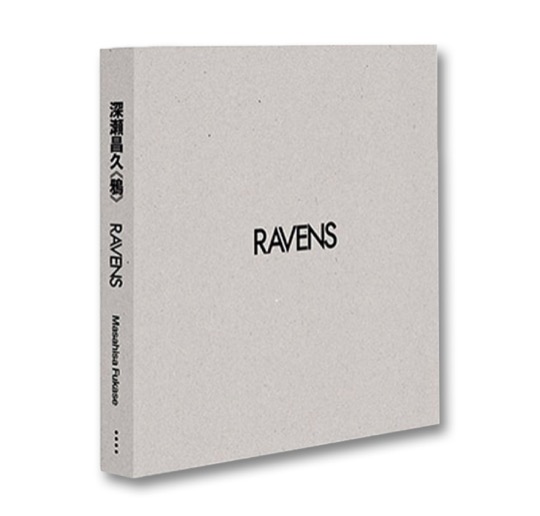
Ravens by Masahisa Fukase, MACK Books edition (2017). Image courtesy MACK Books. Promotional material from the publisher.
The Photographer
Fukase was born in 1934 in Bifuka, on the frozen island of Hokkaido, in a family that ran a photography studio. He studied in Tokyo, worked commercially, but quickly came to treat fine-art photography as the only form capacious enough to hold what was building inside him.
In the 1960s, he entered the circle that defined post-war Japanese photography. Eikoh Hosoe, Shomei Tomatsu, Daido Moriyama - though Fukase was never an official member of Provoke, he shared their restless energy and willingness to push the image into realms of raw, unforgiving subjectivity.
His early series Yohko (1963-1978) is one of the most unsettling acts of photographic devotion we know. Thousands of frames of a single person - his wife. Tenderness and claustrophobia in equal doses. A portrait that, with each frame, said more about the photographer than the subject. When the marriage ended, the project collapsed. And from collapse, something always rises - ravens took to the air...
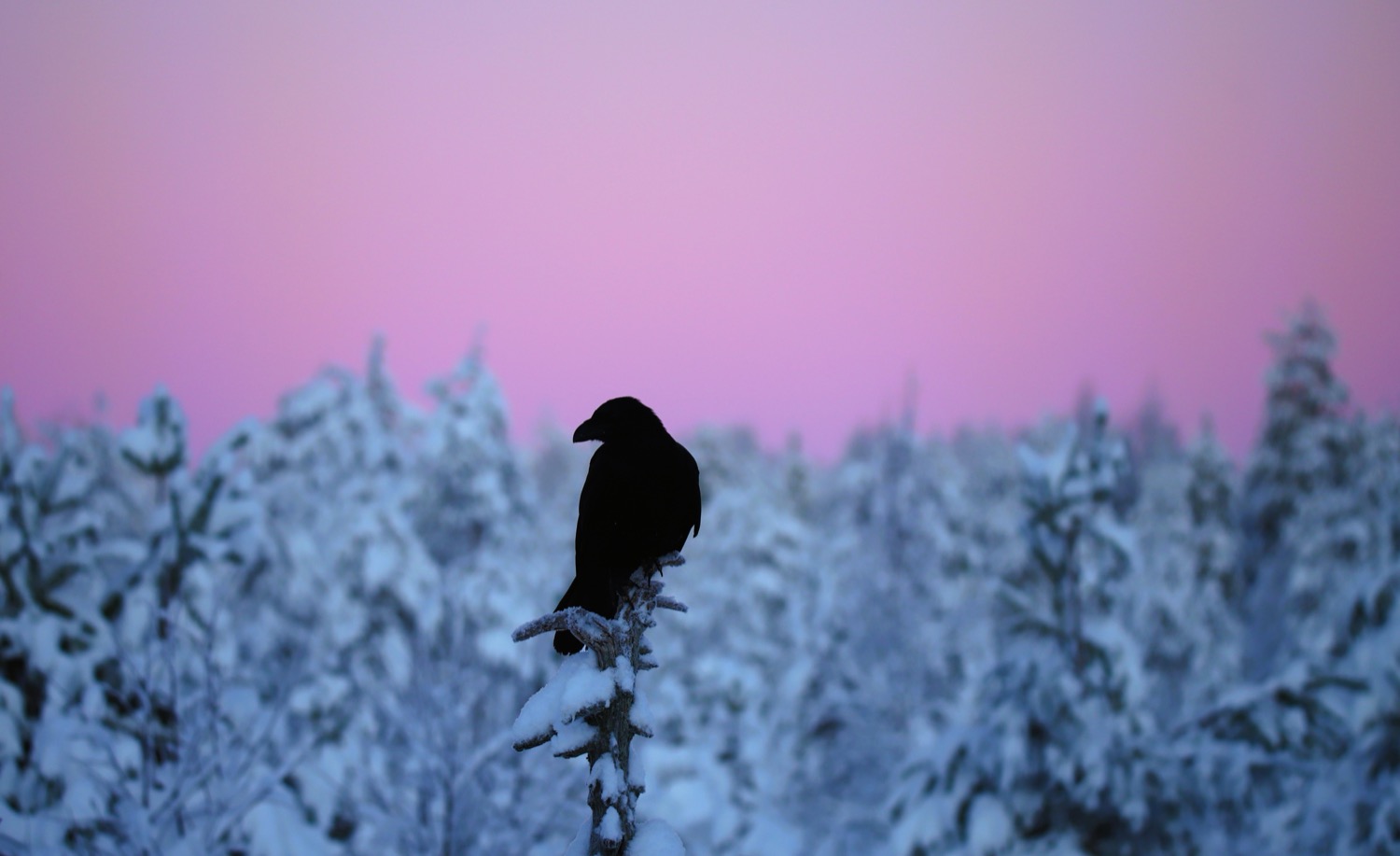
A raven at sunrise on a branch, silhouetted against a moody sky. The solitary figure echoes the atmosphere of Fukase's Ravens. Photo by yrjö jyske, CC BY 4.0. Source
.jpg)
The Making of Ravens
The project that would become The Solitude of Ravens (also known simply as Ravens, or Karasu in Japanese) was born in the mid-1970s from despair and chance. Fukase, devastated by the collapse of his marriage, traveled to Hokkaido with a photographer friend. On a ferry, he saw ravens following the boat - their black silhouettes cutting through the grey, boundless sky.
He started photographing. And did not stop. Over the next decade, he returned to Hokkaido again and again, hunting ravens in snowstorms, on rocky shores, against featureless white skies. With each trip, the images grew darker, more abstract, more desperate. Yohko was about presence - intrusive, all-consuming. Ravens is about absence: the negative space that remains when someone leaves.
The photobook was first published in 1986 by Soshisha, then in an expanded edition in 1991. For years it lived in semi-darkness, known mainly to insiders. The breakthrough came with the 2017 MACK Books reissue, which brought Ravens to the global stage. And rightly so - this book is not, and never was, a collection of wildlife photography. It is a psychological document. A landscape of grief rendered in silver and black.
The Visual Language
Fukase's ravens are not a species, not zoological specimens. They are blurred, grainy, sometimes nearly lost in the frame. He worked with slow shutter speeds, pushed film, and available light - techniques that place him on the line of the are-bure-boke aesthetic of the Provoke generation. But with a difference: in Fukase's hands, these devices are not a program. They are desperation. Blur is not a style. It is a state of mind.
The sequence of images forms a visual poem. A raven in flight becomes an ink smear on white snow. A flock rises from a beach like ash after a fire. A single bird on a wire, the sky so overexposed it looks like a void from which only he emerges. There is no narrative in the traditional sense - only accumulation, intensity, a weight of mood that builds with every page.
Fukase reportedly said that at some point he stopped feeling like a photographer pointing a lens at ravens. He felt he had become one himself. That line is the key to the entire book. Because the images in Ravens are not observations from outside. They are expressions from within.
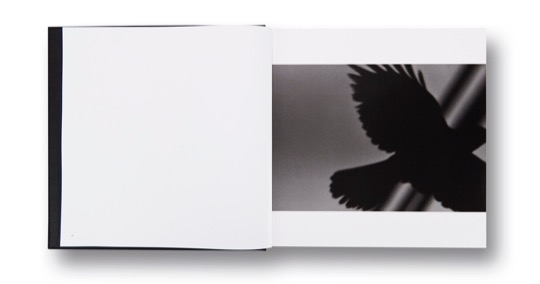
Interior spread from Ravens by Masahisa Fukase - a raven in flight, grainy, high-contrast, blurred. Image courtesy MACK Books. Promotional material from the publisher.
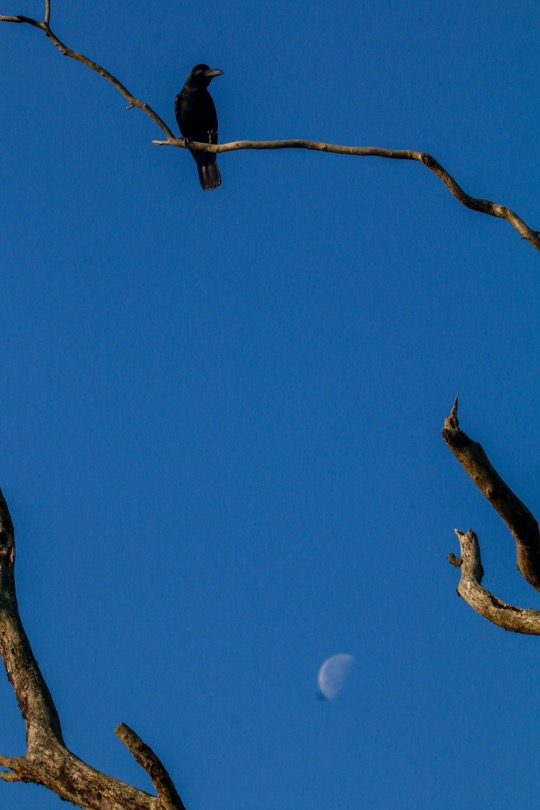
A raven sitting on a branch with the moon in the background. The nocturnal solitude and elemental composition strongly evoke Fukase's photographic language. Photo by Adhish Dulal, CC BY-SA 4.0. Source

A Life Cut Short
Fukase continued photographing after Ravens - the playful Bukubuku series, the autobiographical Family - but the ravens defined him. He never fully stepped out of their shadow. I don't think he tried.
In 2012, at 78, Fukase died from injuries sustained in a fall at a bar in Tokyo. He had been drinking alone. The circumstances - ambiguous, like everything in his biography. The death added one final, darkest layer to a legacy already marked by shadow.
A year later, Ravens was reissued by MACK to critical acclaim. The Guardian renewed its declaration - "the finest photobook of the past 25 years." And that consensus, it turned out, has only deepened.
Legacy
Ravens has influenced generations - not just Japanese photographers, but Western artists who found something universal in Fukase's black. Its success opened the door for a wave of Japanese photobooks on the international market.
In 2025, a biographical film titled Ravens was released, starring Tadanobu Asano as Fukase. It tells his story from the Yohko years through the raven obsession to the book's publication. The very fact that someone deemed this story worth telling on the big screen says it all: Fukase is not just a photographer who took pictures of birds. He is a parable about obsession, loss, and the strange alchemy by which personal darkness can become lasting art.
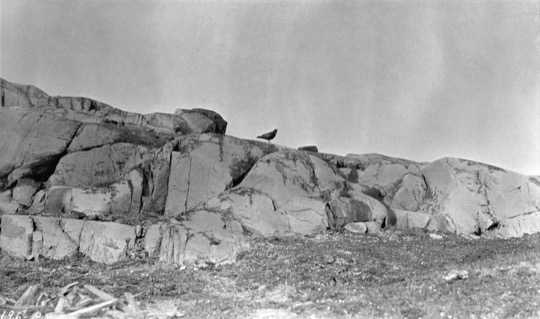
Vintage black-and-white photograph of a raven silhouetted against the arctic sky at Cape Barrow, Nunavut, 1915. The archival grain and starkness echo the analog feel of Fukase's prints. Photo by Rudolph Martin Anderson, CC BY-SA 4.0. Source
.jpg)
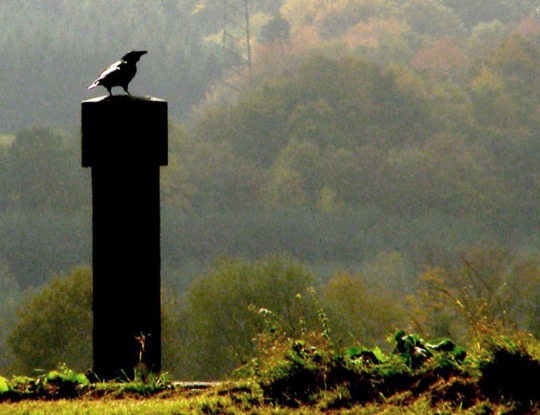
A raven in dramatic black and white. The moody, dark-toned composition and bokeh background echo the dramatic chiaroscuro of Fukase's work. Photo by Erich Ferdinand, CC BY 2.0. Source
.jpg)
The Solitude Remains
What makes The Solitude of Ravens endure is not technical innovation or historical significance. It is simpler: the images feel true. The ravens are not symbols. They are not metaphors for anything specific. They are what they are - birds, darkness, absence. And that is enough.
Fukase gave us permission to photograph what we cannot explain. To turn the camera not into a tool of documentation but an instrument of feeling. To accept that the most powerful images often arrive when we stop trying to understand.
The ravens are still there, frozen in silver, flying across pages. And we are still watching them, trying to see what Fukase saw.
Further reading
- Masahisa Fukase Archives - official site with biography and complete exhibition history
- Masahisa Fukase at SFMOMA - works in the collection
- Masahisa Fukase at The Met - works in the collection
- Ravens at Michael Hoppen Gallery - representative gallery
- The Guardian: The best photobook of the past 25 years? - 2010 review
- The Guardian: the man who photographed nothing but his wife - 2015 profile
- BBC News: Solitude of Ravens in pictures - gallery
- Books on Japanese photography on Amazon
Co-created by human and AI.