Some links on this site may be affiliate links
Provoke: The Three Issues That Changed Photography
Provoke: The Three Issues That Changed Photography
Between November 1968 and August 1969, a small Tokyo magazine published three issues and changed the course of photography. Its name was Provoke, and its subtitle read: "Provocative documents for thought." It was rough, confrontational, and deliberately ugly. Fifty years later, we are still catching up to what it tried to do.
The World That Made Provoke
Japan in the late 1960s was a country in upheaval. The postwar economic miracle had transformed cities into sprawling concrete landscapes, but the human cost was visible everywhere. Student protests against the US-Japan Security Treaty (Anpo) filled the streets. The shadow of Hiroshima and Nagasaki remained unprocessed. Traditional social structures were dissolving, replaced by a consumer culture that felt both foreign and hollow.
It was in this atmosphere of protest, alienation, and accelerated change that a group of young photographers and writers came together. They shared a conviction that existing photography - documentary, journalistic, pictorial - was inadequate. It was too tidy, too explanatory, too comfortable with the world as it was presented. They wanted something else.
The Founders and the Manifesto
Provoke was founded by five people: critic and philosopher Koji Taki, photographer Takuma Nakahira, photographer Yutaka Takanashi, writer Takahiko Okada, and, from the second issue, photographer Daido Moriyama. They were young, in their twenties and early thirties, and they operated outside the established photographic institutions of Japan.
The manifesto, written by Taki, declared that photography could capture "fragments of reality that cannot be expressed in language as it is." In an age where words had lost their material base, the camera could produce documents that preceded ideology, that could provoke thought rather than confirm existing beliefs.
This was not a technical statement but a philosophical one. Provoke was not interested in better composition or sharper focus. It was interested in whether photography could break through the noise of a mediated world and touch something real.
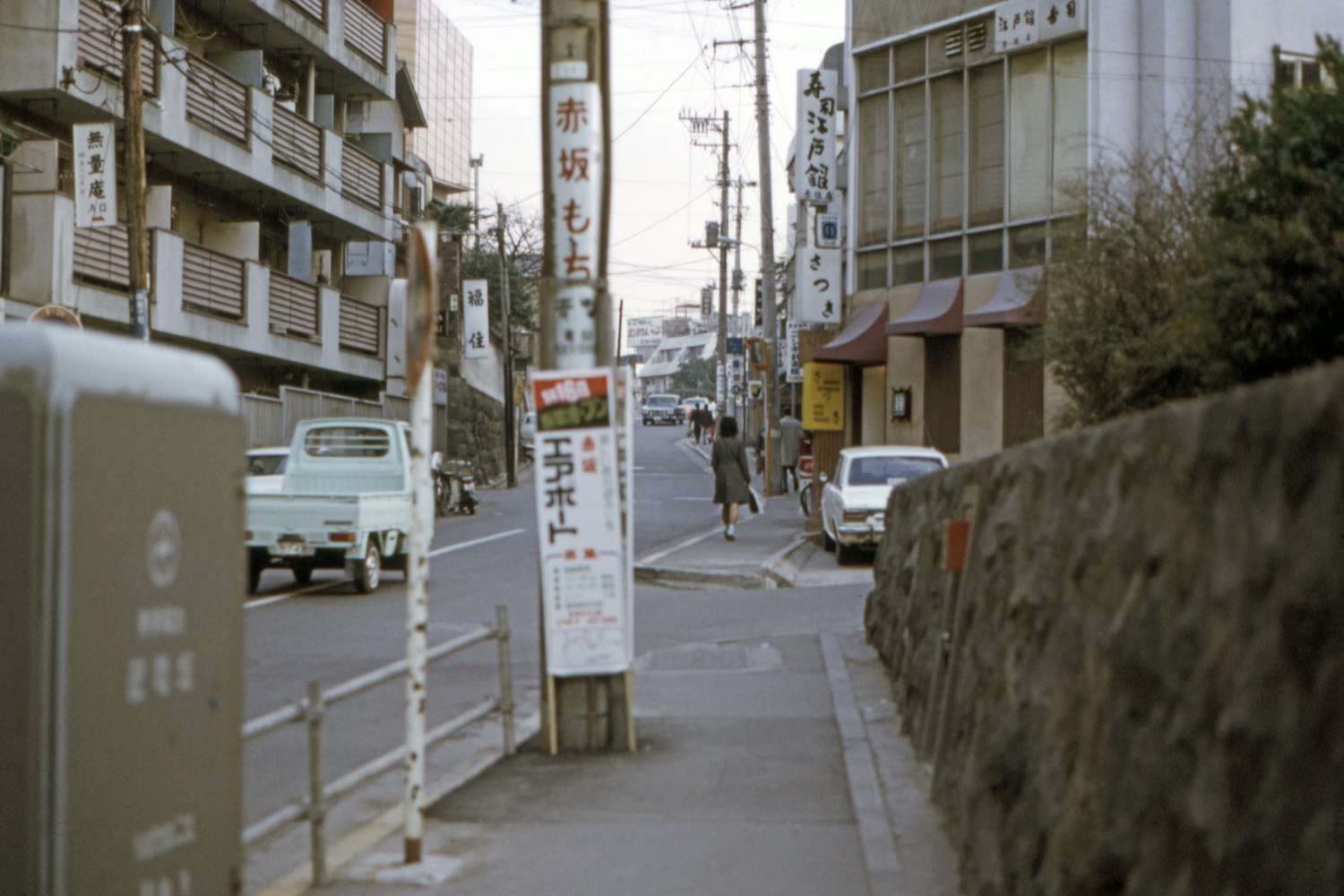
Tokyo street view, found photograph from 1973. The cluttered visual field of signs, utility poles, and shopfronts captures the urban landscape that Provoke photographers inhabited. Photo by David Pirmann, CC BY 2.0. Source
.jpg)
Are, Bure, Boke: A Philosophy of Imperfection
The phrase most often associated with Provoke is are, bure, boke - rough, blurry, out of focus. These terms are sometimes treated as a style, a look that can be replicated with the right camera settings or a smartphone filter. But for the Provoke photographers, they were not aesthetic preferences. They were ethical positions.
Are (rough/grainy): High-speed film pushed beyond its limits, coarse grain visible across the image. The photograph announces itself as a material object, not a transparent window onto the world. The grain is the medium asserting its presence.
Bure (blurry): Movement captured at slow shutter speeds, the camera moving with the photographer's body. The blur is not a mistake but a record of duration, of the photographer being in motion, of the world not holding still.
Boke (out of focus): Shallow depth of field, missed focus, images that refuse to resolve into clarity. The subject remains ambiguous, open to interpretation. The photograph asks questions instead of providing answers.
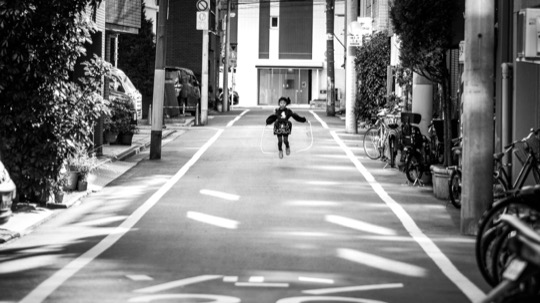
A candid street portrait in Tokyo - grainy, immediate, alive. The shallow depth of field and fast aperture echo the are-bure-boke philosophy. Photo by Giuseppe Milo, CC BY 3.0. Source
.jpeg)
Together, these three qualities formed a visual language that rejected the clarity and objectivity that had defined documentary photography. Where Cartier-Bresson sought the decisive moment, Provoke sought the indeterminate one. Where the dominant tradition saw photography as a tool for capturing reality, Provoke saw it as a tool for questioning whether reality could be captured at all.
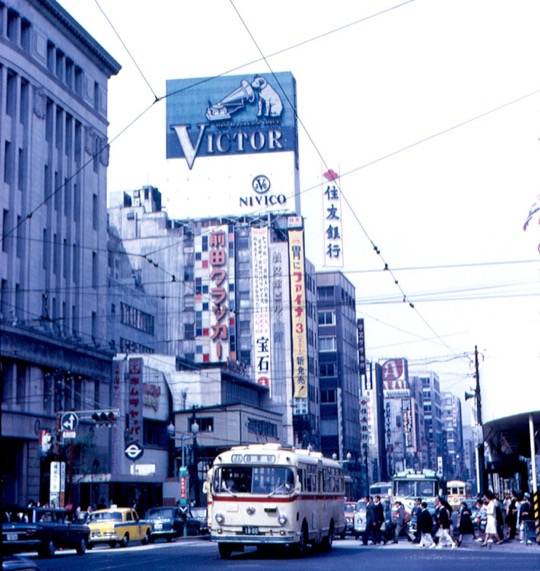
Chuo-Dori, the main street in Ginza, Tokyo, looking north from the Ginza intersection in May 1967. Photographed in the same year the first issue of Provoke was being prepared. Photo by Roger Wollstadt, CC BY-SA 2.0. Source
.jpg)
The Three Issues
The first issue of Provoke appeared in November 1968 with a print run of only a few hundred copies. It was crudely produced, printed on cheap paper, and laid out in a dense, confrontational style. Images bled off the page. Text was set in irregular blocks. The whole thing looked like a fanzine, not an art magazine.
The second issue, themed around eros, followed in March 1969. It was here that Daido Moriyama joined the group, bringing with him a more extreme version of the are-bure-boke aesthetic. His images - high contrast, nearly abstract, aggressively cropped - pushed the magazine's visual language even further.
The third and final issue arrived in August 1969. It is often considered the most radical of the three. The images are darker, more fragmented. The layout is even more aggressive. The magazine seems to be deconstructing itself, pushing toward a limit where photography threatens to dissolve into pure gesture.
A single book, First, Throw Out Verisimilitude: Thoughts on Photography and Language, was published in March 1970 as a final statement. After that, the group dissolved. Three issues, one book, and it was over.
The Key Photographers
Takuma Nakahira was perhaps the most theoretically driven of the group. His work from this period is cerebral and confrontational, questioning the very act of seeing. His 1970 book For a Language to Come is a landmark of photographic publishing. Nakahira later disavowed his own work, destroying negatives and distancing himself from the movement, which only added to its mystique.
Yutaka Takanashi brought a more measured, observational eye. His series Towards the City (1970) documents Tokyo with a cool, almost detached precision that contrasts with the chaos of Moriyama and Nakahira. Takanashi's work shows that Provoke was not a single style but a shared question: what can photography do?
Daido Moriyama needs no introduction. He is the most famous of the group, the one whose name has become synonymous with Japanese street photography. His contribution to Provoke was a kind of visual extremism - images pushed to the edge of legibility, photographs that feel like punches. Moriyama's later work, particularly his photobook Farewell Photography (1972), extended the Provoke sensibility into a full-blown assault on the medium.
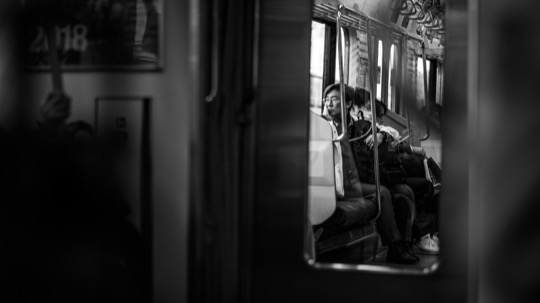
Contemporary street photograph shot in the are-bure-boke tradition: grainy, candid, and immediate. Tokyo subway, shot with Fujifilm X-Pro2 at f/1.2. Photo by Giuseppe Milo, CC BY 3.0. Source
.jpeg)
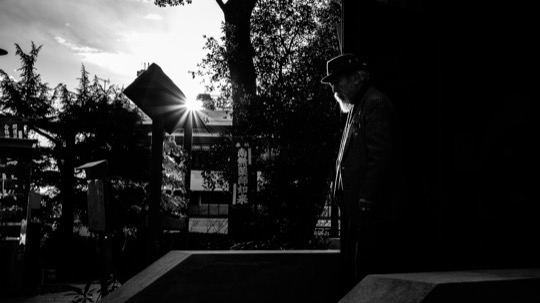
Ueno Park, Tokyo. A lone figure crossing the frame in high-contrast black and white, capturing the Provoke aesthetic of everyday urban solitude. Photo by Giuseppe Milo, CC BY 3.0. Source
.jpeg)
Legacy: What Provoke Left Behind
Provoke disappeared almost as quickly as it appeared. But its influence only grew. In Japan, the magazine became a touchstone for subsequent generations of photographers. The are-bure-boke aesthetic was absorbed, adapted, and eventually codified as a distinct tradition within Japanese photography.
Internationally, recognition came more slowly. It was not until the 1990s and early 2000s that exhibitions like SFMOMA's "The Provoke Era" (2009) and major retrospectives of Moriyama and Nakahira brought the movement to Western attention. When the work arrived, it hit hard. Here was a photography that had anticipated everything - the rejection of objective truth, the embrace of the subjective, the use of the camera as a philosophical instrument.
Today, the influence of Provoke is visible everywhere. In the grainy, high-contrast street photography that fills social media. In the work of contemporary photographers who deliberately blur their images or push their cameras beyond their technical limits. In the simple permission to make photographs that do not look like photographs.
But the deepest legacy of Provoke is not a style. It is an idea: that photography is not about capturing what is already there, but about making visible what could not be seen before. That the most powerful images are not the ones that show us the world clearly, but the ones that force us to look again.
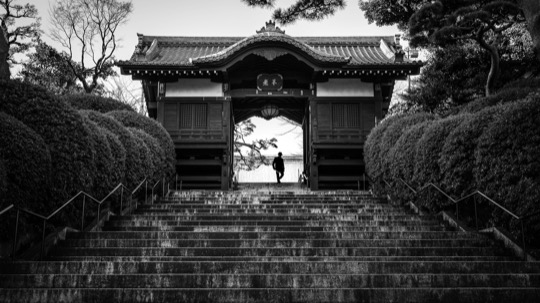
A man walking through Bunkyo, Tokyo, near a temple. High-contrast black-and-white street photography channeling the Provoke tradition. Photo by Giuseppe Milo, CC BY 3.0. Source
.jpeg)
The Provocation Continues
What makes Provoke remarkable, even now, is that it asked a question most photographers never consider: what if photography's purpose is not to communicate but to disrupt? Not to document but to unsettle? Not to be beautiful but to be true?
In an age of perfectly polished Instagram feeds, algorithm-optimized compositions, and AI-generated imagery, the Provoke question feels more urgent than ever. The world does not need more tidy, well-composed photographs. It needs images that resist, that scratch, that refuse to be consumed easily.
Three issues. One book. Fifty years later, still provoking.
Further reading
- William Klein: The Original Provocateur - the photographer who inspired Provoke
- Daido Moriyama on Wikipedia
- The Provoke Era at SFMOMA
- Photobooks: Provoke at Tate Modern
- Books on Japanese photography on Amazon
Co-created by human and AI.