Some links on this site may be affiliate links
The Thumb: The Story of One Photograph
In the lower right corner of the print there is a thumb. It comes out from behind a blanket and rests against the pole that holds up the canvas. In the version we know, that thumb is gone. What remains is a blur, invisible until the two prints are placed side by side.
The photograph is called Migrant Mother. Dorothea Lange made it in March 1936 in Nipomo, California, while working for the Resettlement Administration. For decades nobody knew the woman's name. For the first forty years, the photograph did not know it either.
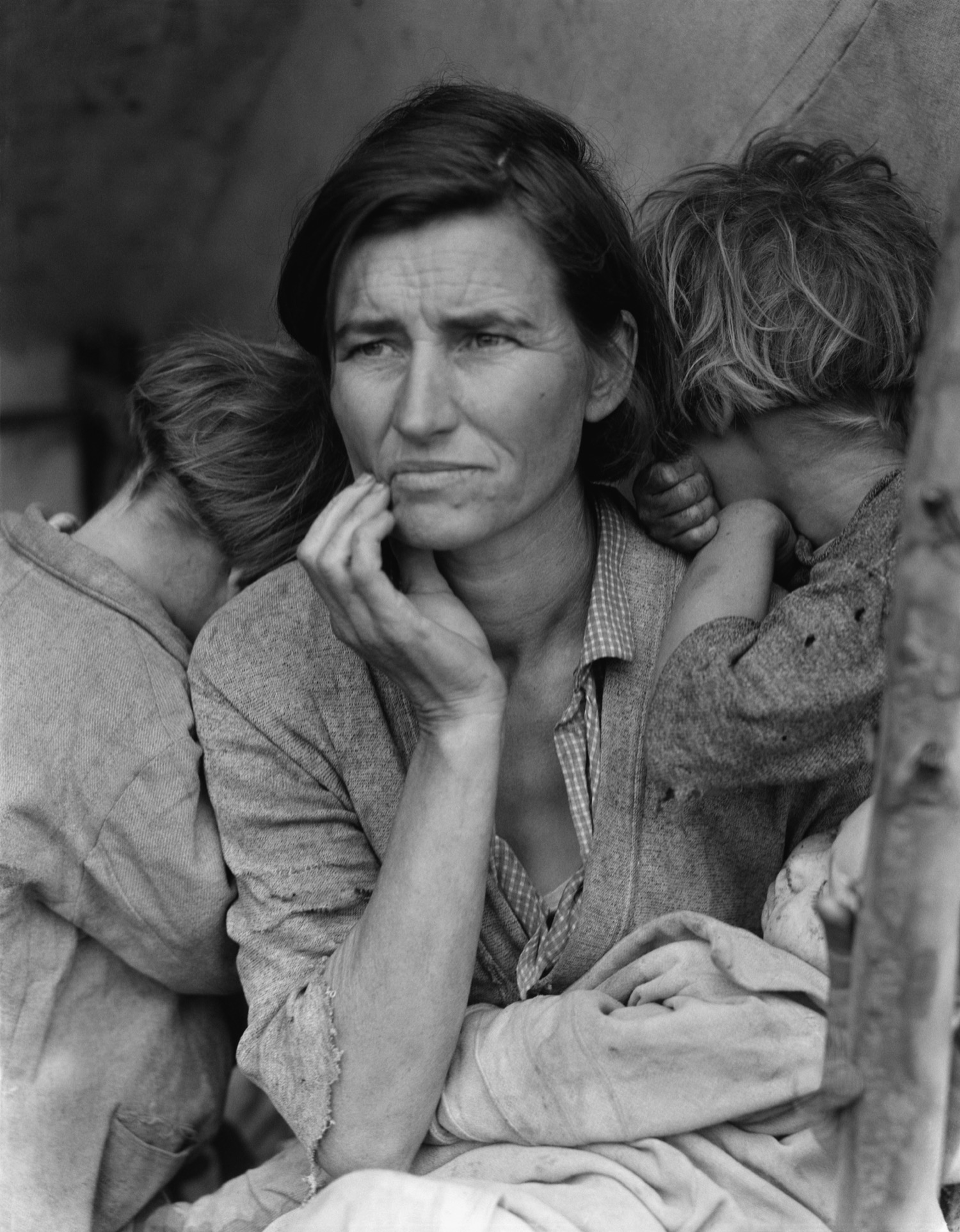
Dorothea Lange, Migrant Mother, 1936. Library of Congress, FSA/OWI Collection, negative LC-USF34-9058-C, no known restrictions on publication. Source
The Frame
Before this frame existed, Lange was standing further away.
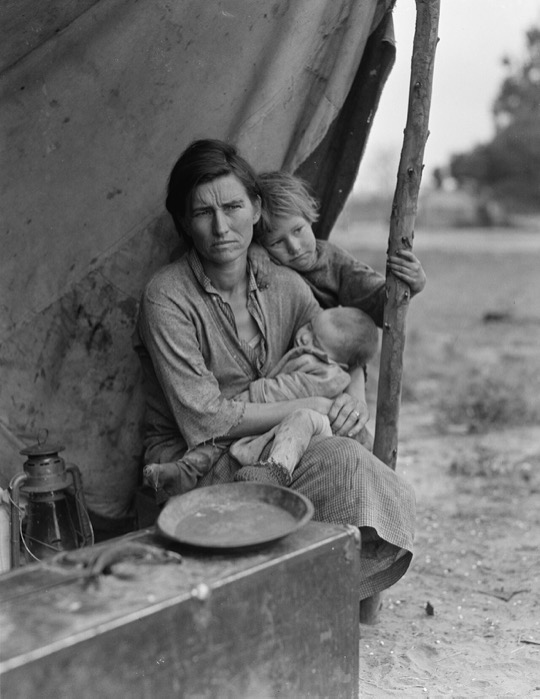
The same session, the frame before the close-up. Dorothea Lange, 1936. Library of Congress, FSA/OWI Collection, via Wikimedia Commons. Source

The wider frame contains things the icon does not: a kerosene lantern, a tin pan resting on a trunk, a second girl leaning on her mother's shoulder and holding the pole. It also shows that the tent is not a tent, only a piece of canvas stretched on a few poles.
In a 1960 account Lange described the scene briefly: she walked up, made five exposures, moving closer each time from the same direction. She did not ask for a name or a history. She added that the woman seemed to know the pictures might help her, and so she helped, and that there was something of equality in it. Quoted by the Library of Congress
That is the photographer's version. The archive adds its own reservation, and it matters more than it looks: from the negative numbers the order of the exposures cannot be established. The numbers were assigned later, in an office. Extended captions and notes from that session have not been found in the FSA written records. Library of Congress
The Card
A card is glued to the print. Someone typed a sentence on it: "Destitute peapickers in California; a 32 year old mother of seven children. February, 1936." Below it, a stamp with the negative number and a note that the photograph was made by Dorothea Lange. Own observation of the reproduction

The Library of Congress catalog dates the photograph to March 1936. The card says February. One of those dates is wrong, and neither carries the name of the person who typed it.
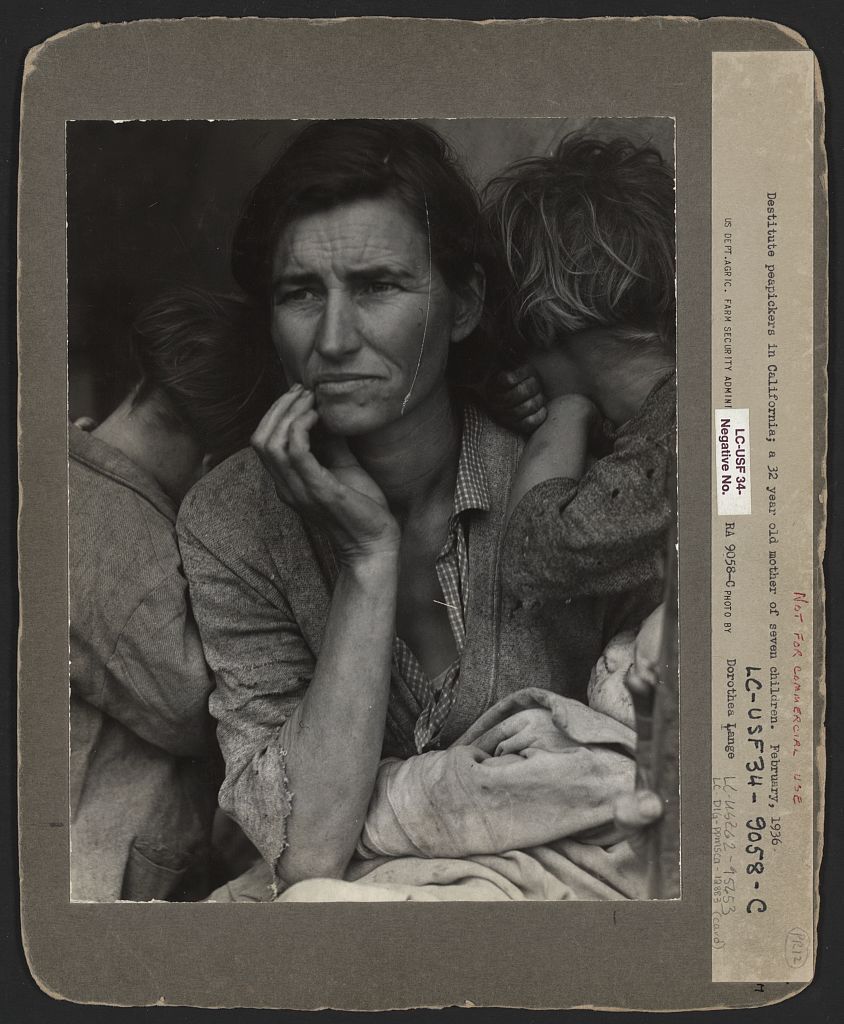
The print before retouching, mounted on board with its caption card. Dorothea Lange, 1936. Library of Congress, Prints & Photographs Division, LC-DIG-ppmsca-12883. Source
It is worth pausing on what the card does. It does not describe the photograph. It edits it. A woman who at that moment was travelling with her family, waiting for someone to repair a car, becomes a "destitute pea picker". A particular person becomes a type, and a type is more convenient: it can be printed in a newspaper and nobody asks for a surname.
According to Sarah Meister of the Museum of Modern Art, the captions for this series were most likely derived from wire-service reports published in newspapers at the time. MoMA That cautious "most likely" is the whole point. We do not know who wrote the sentences that explained this photograph to America for decades.
On the same card, someone wrote in red: Not for commercial use. The Library of Congress research guide for the collection states something else: there are no known restrictions on the use of these images. Library of Congress Two contradictory messages on one piece of board, side by side, for eighty years.
The Retouch
The Library of Congress record says it plainly: the negative was retouched in the 1930s to erase the thumb holding a tent pole in the lower right corner. Library of Congress Meister dates the decision more precisely: 1939, when Lange had an assistant retouch it. Meister's book
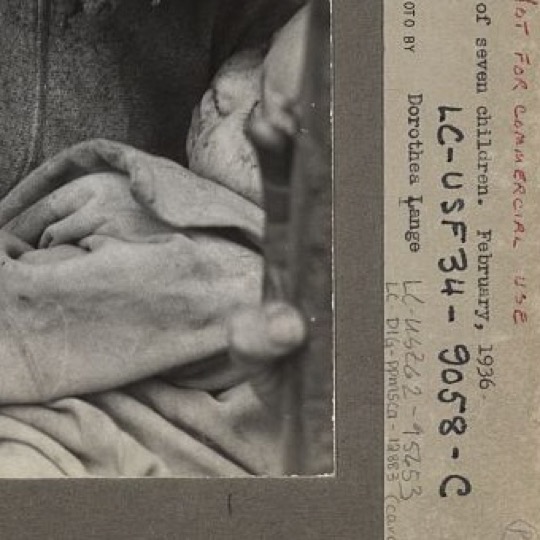
A crop of the same print as above. The thumb rests against the pole holding up the canvas. Dorothea Lange, 1936. Library of Congress, LC-DIG-ppmsca-12883. Source
The thumb was not a mistake. It was part of the sentence the photograph speaks: a woman sitting in a makeshift shelter, in which somebody has to hold the structure up. With the thumb, something else disappeared that cannot be pointed at: the information that the scene required support.
Accounts of the decision repeat one detail: Roy Stryker, who ran the photography unit at the FSA, was said to be unhappy about it, because it undermined trust in the documentary character of the whole project. That claim comes from Meister, not from a document. The record of the decision itself has not survived. Its effect did.
The Person
In 1978 the press reached the woman in the photograph. Her name was Florence Owens Thompson. She said something that is hard to read next to Lange's account of equality: "I wish she hadn't taken my picture. I can't get a penny out of it. [Lange] didn't ask my name. She said she wouldn't sell the pictures. She said she'd send me a copy. She never did." National Gallery of Art
Thompson was not a pea picker. She was travelling with her family, the car broke down, her husband and son walked into town for help. The photograph exists because someone was waiting by the road. National Gallery of Art
She was also of Cherokee heritage. Tate This is not a biographical detail, it is a detail of the caption. The card from 1936 described her as a pea picker in California, and the project behind the photograph was meant to show the hardship of white farm workers. For forty years nobody checked.
How Many Frames
Lange speaks of five exposures. The Library of Congress holds five frames from the session and at the same time notes that two more, medium-range views, never reached it and are held at the Oakland Museum. The MoMA book speaks of seven exposures. Library of Congress
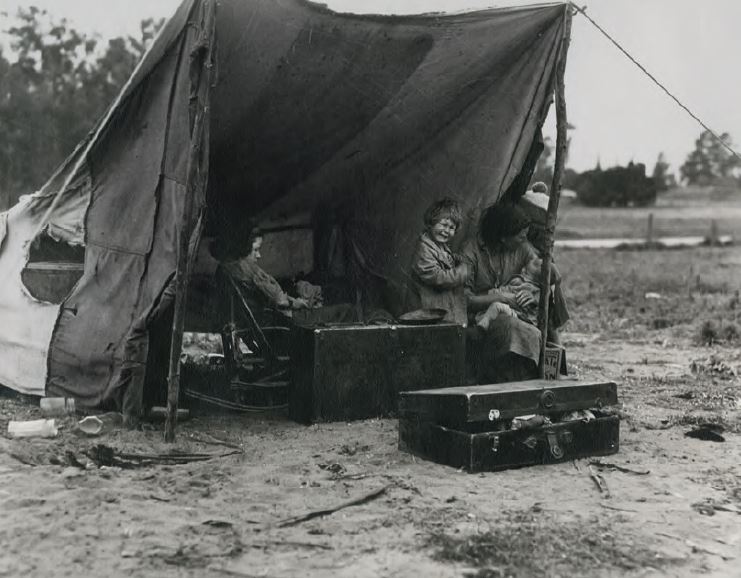
A frame from the same session that the Library of Congress does not hold. Dorothea Lange, 1936. Oakland Museum of California, via Wikimedia Commons. Source

So it is impossible to say how many photographs were made that day, just as it is impossible to say in what order. What remains is a series in which one frame received a caption, a mount, a retouch and a life, and the others stayed in the archive as evidence against it.
The thumb left the negative but stayed on the print that someone put back in a folder. All it took was that nobody threw it away.
Further reading
- Library of Congress: Dorothea Lange's "Migrant Mother" Photographs - a guide to the series, noting that the order of the frames cannot be established
- Library of Congress: negative record LC-USF34-9058-C - the note about the retouched thumb and the rights statement
- MoMA Magazine: Sarah Meister, Piecing Together Dorothea Lange's Migrant Mother - the curator on what can and cannot be established
- Sarah Meister, Dorothea Lange: Migrant Mother, MoMA, 2018 - a book devoted to a single photograph
- National Gallery of Art: The Real Lives of People in Dorothea Lange's Portraits - who Florence Owens Thompson was and how she came to be there
- Tate: Migrant Mother, Nipomo, California - the object record with the 1978 quotation
Co-created by human and AI.