Some links on this site may be affiliate links
The Second Photograph
At the corner of Bloor Street and Avenue Road in Toronto there is a church so squeezed between towers that you have to look for it. The photographer Paul Fenton joined two pictures of the same street corner into one: one from 1925, when a streetcar passed the church, and a modern one taken from the same spot eighty-seven years later. The church from the old picture sits in the new one exactly where it used to be.
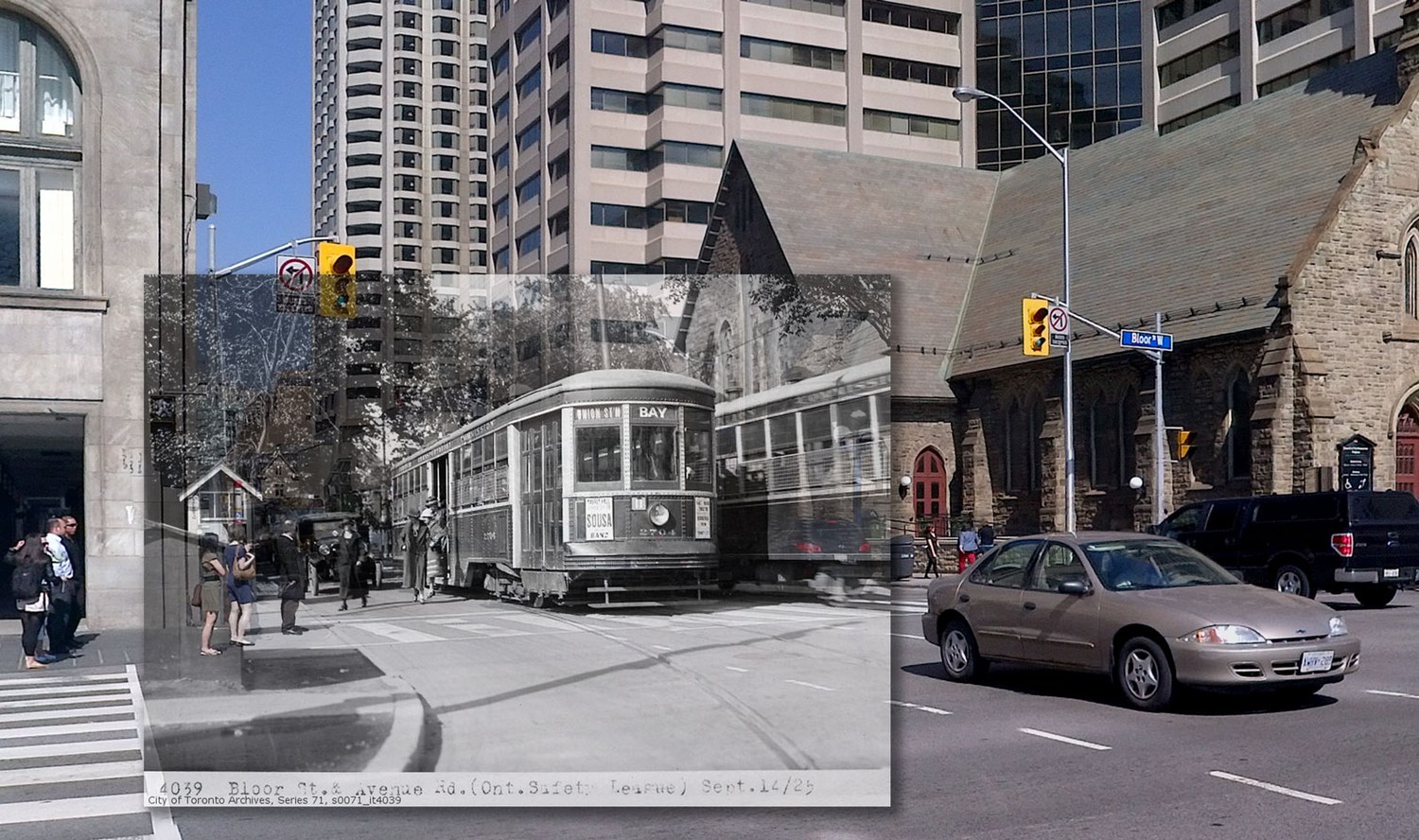
The same corner of Bloor Street and Avenue Road in Toronto: an archival photograph from 1925 (Alfred Pearson, City of Toronto Archives) joined with a 2012 view. Author: Interactive images, CC BY 2.0. Source

Such pictures have a name. Rephotography, the act of photographing the same site again after a lapse of time. We usually call it "then and now." They are made for science: to measure retreating glaciers, erosion, the spread of cities. They are also made for sentiment, and in that there is something science cannot yet quite explain.
Because when you return to photograph the same place, you end up comparing not the image to the place but one frame to the next, except that one of them has lived in your head so long that it stopped being a picture at all. It became a memory, a version of something lost.
Douglas Levere returned to more than a hundred locations from Berenice Abbott's Changing New York, shot in the thirties. He came back to the same corner at the same season, at the same time of day, waiting for the shadow to fall on the same wall as before. The technique was meant to be as precise as surveying, and for a moment it really was. Here is the first trouble: how much precision does it take for the second picture to tell the truth about a place? The more faithfully you repeat the frame, the clearer it becomes that something does not line up. And that something is not always the city.
Andrzej Maciejewski did something similar with Montreal at the end of the nineteenth century. He repeated the views of William Notman, who photographed that city as an era was closing. Looking at these pairs, it is hard not to feel that the same two photographers stand at the same point, and that one of them simply disappeared. Only the angle of his camera remains, the place he looked from.
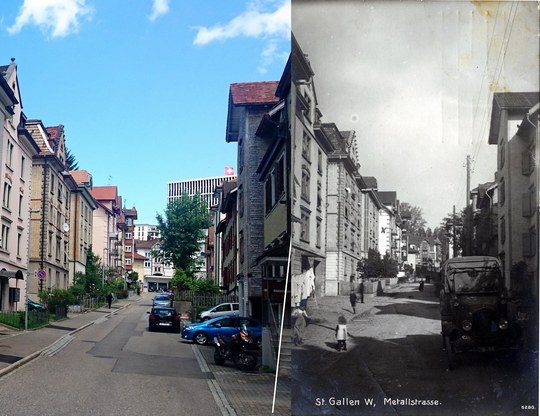
Metallstrasse in Saint Gallen, Switzerland: the view from 1920 (Stadtarchiv St. Gallen) joined with the view from 2017. Author: EtschPat and an anonymous author, CC BY-SA 4.0. Source

The best-known rephotography was done in America, in the deserts and mountains, where change happened over years. The same rock faces were photographed over decades, to measure time with the land itself. I can think of no sadder occupation. A man spends his life proving that the place he loves is slowly vanishing. In Virginia City, Nevada, views from the early 1870s were set next to views from 2007. The burned mining town was rebuilt and then emptied again. The comparison shows the church, the poles, and something else if you look closely. The 2007 view is plainly lonely. The first one is full of people, wagons, a stairway with no railing.
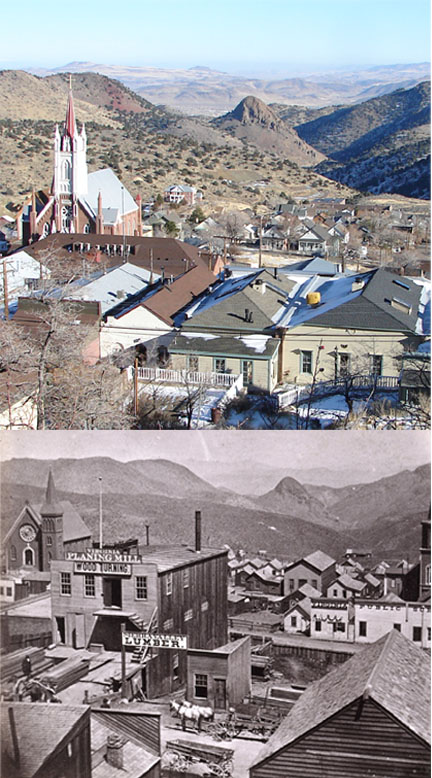
Virginia City, Nevada: a view from the early 1870s (St. Mary's church burned in the fire of 1875) joined with a view from 2007. Author: Rick Cooper, CC BY 2.0. Source

I wonder whether these comparisons are about the place at all. They begin with curiosity about what happened to it. They end with the question of what happened to me, to us, since then. A second photograph of the same tree does not really show what grew. It shows how much you grew, standing, in truth, right there beside it - on the same line of time. The tree has no idea you are measuring it. What disappears is a plain habit: you watch your earlier self watching the tree, back when you still knew how to watch a tree.
Rephotography was invented as a scientific method meant to remove subjectivity. What remains most interesting and most human about it is the failure of that plan. The camera stands still on its tripod, but someone else is looking through the viewfinder. The scientist measures the retreat of a glacier and does not notice that his own certainty is retreating too. There are pairs of before-and-after glacier photographs made by researchers. The comparison was meant to be a dry table. It is instead devastating, because in one frame the ice reaches down into the valley and in the other only gravel and a few tufts of grass remain. And also because none of us existed for the first picture, while we are still there for the second.
Maybe that is why these "then and now" images spread so easily online. Beneath the look of a curiosity they carry something no one meant to put there: plain proof that the point you look from is the one thing that keeps existing while everything around it changes. It is easy to call that point a point of view and forget that it is only you. The view stays. The camera leaves.
A question remains, and I have no ready answer. Is a second "same-photograph" even possible? Because if every return shows the place through the lens of the original frame, then each time you photograph not the place but your own relationship to yourself years ago. Perhaps there is no such thing as returning to a place. Perhaps every time you photograph the same place and compare it to memory, you begin to understand that there was never, and will never be, any chance of going back.
Further Reading
- Rephotography, Wikipedia - the entry on repeat photography
- Mark Klett, crown of the continent - rephotography of the American West
- New York Changing by Douglas Levere - over a hundred returns to Berenice Abbott's pictures
- After Notman by Andrzej Maciejewski - Notman's Montreal repeated, at the PHSC
Co-created by human and AI.