Some links on this site may be affiliate links.
Hiroshi Sugimoto and Woman in the Dunes: The Horizon That Never Lets Go
There is a scene in Hiroshi Teshigahara's Woman in the Dunes that I cannot stop thinking about. The protagonist, an entomologist collecting rare insects among the dunes, wakes up at the bottom of a sand pit. He lies on his back. Above him - a patch of sky. A rectangle, a square, a frame. The sky is not infinite. It is a crop.
The same thing happens in Hiroshi Sugimoto's Seascapes. Photographs of water and air, cut by the horizon exactly at the center. No land. No boat. No gull. No cloud. Just a line. And that line - like the edge of the pit in Teshigahara's film - is not an opening. It is a boundary.
Sugimoto says it plainly: "A sharp horizon line and a cloudless sky - here began my consciousness." The woman in the dunes could say the same. To wake up in a place where the horizon is your only reference point, and to understand that consciousness is not freedom but the awareness of limitation.
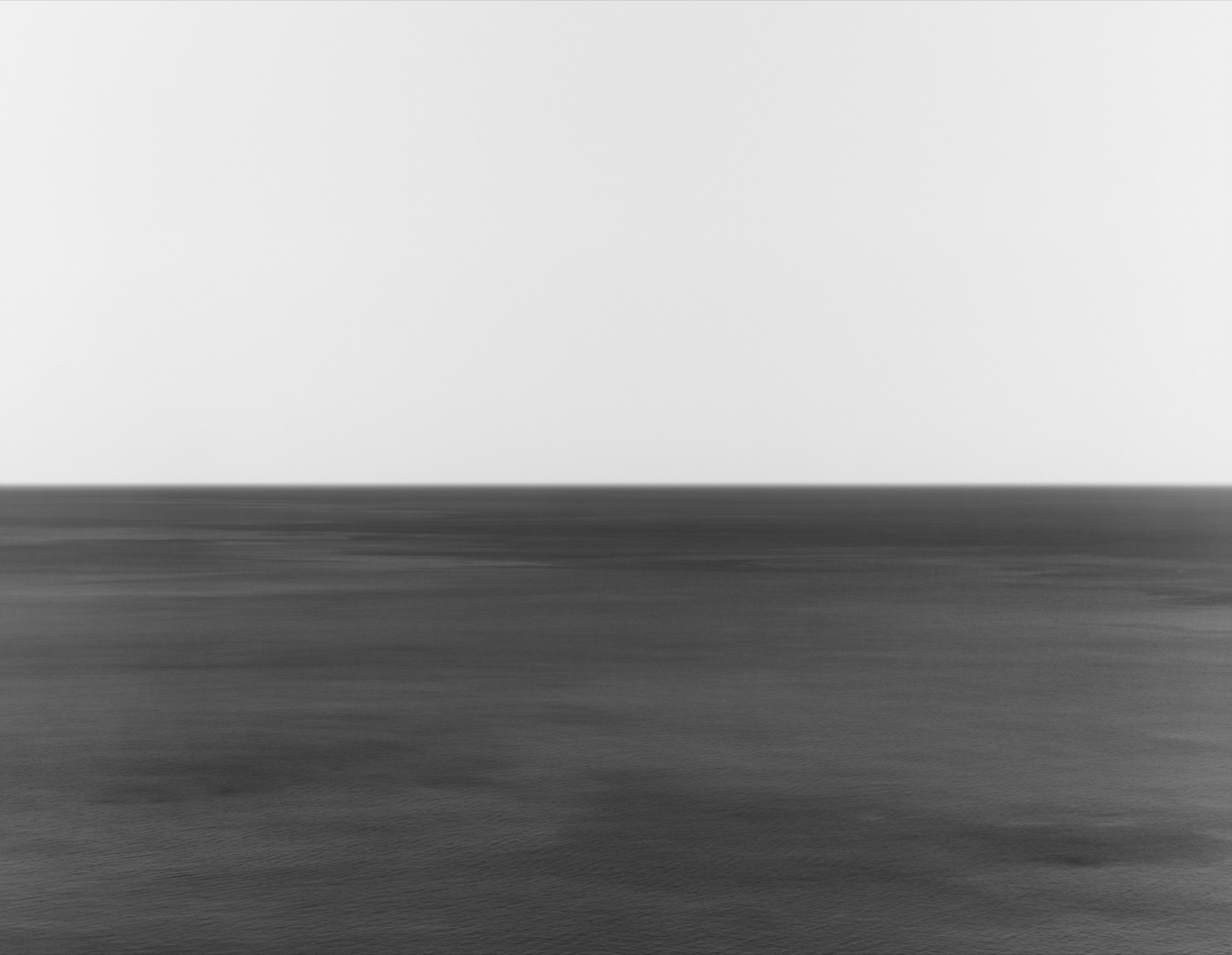
Tasman Sea, Rocky Cape, 2016. Hiroshi Sugimoto. Promotional material: Fraenkel Gallery
I pair these two artists not because both are Japanese. Not because both worked in black and white. But because each built his most important work around the same boundary - a line that cannot be crossed, yet without which the image has no meaning. Sugimoto had his horizon. Teshigahara had the edge of the pit. Both are the same thing: a threshold that divides the world into what is reachable and what lies beyond.
Sugimoto has been photographing the sea since 1980. The same photographs. The same composition. Horizon dead center. Water below, air above. Sometimes neither element has texture - smooth as gray light. Sometimes a ripple appears, a wrinkle, a streak of light. Each photograph asks the same question: what is on the other side?
Is There Something on the Other Side?
In Teshigahara's Woman in the Dunes, the answer is brutal. On the other side of the horizon is another dune. And another. And another. The landscape does not evolve. It repeats. The protagonist tries to escape, returns, negotiates with the villagers who keep him prisoner. Eventually he stops. It is the realization that every horizon leads to another. That maybe a boundary is not an obstacle. It is a place.
Sugimoto has a series that connects these two stories. Theaters are photographs of empty cinemas, exposed for the duration of an entire film. A two-hour screening. Sugimoto keeps the shutter open the whole time. The result: a white rectangle in the center of a dark room. A completed film reduced to a box of light.
This is exactly what Teshigahara does with sand in his film. Time materializes in falling grains. The protagonist cannot stop it. He can only watch.
On the Other Side There Is Always a Choice
Perhaps the most powerful moment in Woman in the Dunes is not the despair or the fear. It is the scene where the protagonist, despite the possibility of escape, returns. Voluntarily. He stays in the pit. Not because he must. Because he chose to.
Sugimoto has been doing the same for forty years. Returning to the same coast, the same spot, the same camera, the same time of day. The horizon line is identical every time. Only the light is different. Only the state of the water is different. Only he is different.
This is not persistence. This is not obsession. It is the decision that the boundary we set for ourselves may be exactly right. That one does not need to go further.
In one interview, Sugimoto said: "My photographs exist in a space between objects that bamboozle and people who are bamboozled." I have a feeling that the core idea of Woman in the Dunes manifests in the same space. Sand that looks like sand but is a wall. Sky that looks like an exit but is a ceiling. A horizon that looks like a promise but is only a line.
Neither of these works offers an answer. They do not tell us whether the protagonist made the right choice. They do not tell us whether Sugimoto finally found what he was looking for, or whether Teshigahara's protagonist truly wanted to return.
Maybe that is the point. Not whether we can cross the horizon. But whether we can learn to live with it.
Further Reading
- Woman in the Dunes - Criterion Collection
- Seascapes - Sugimoto's photography series
- Theaters - Sugimoto's photography series
- Hiroshi Teshigahara - Wikipedia
- Books on Japanese photography at Amazon
Co-created by human and AI.