Some links on this site may be affiliate links
The Contact Sheet
A contact sheet is made in the darkroom. A negative is placed directly on photographic paper and exposed to light. Each frame appears at the same size it had on the film.
Rows of small images fill the sheet. Someone has written a number beside one, or marked it in pencil. The photograph ends at the edge of the frame; the choice of which frame to show comes later.
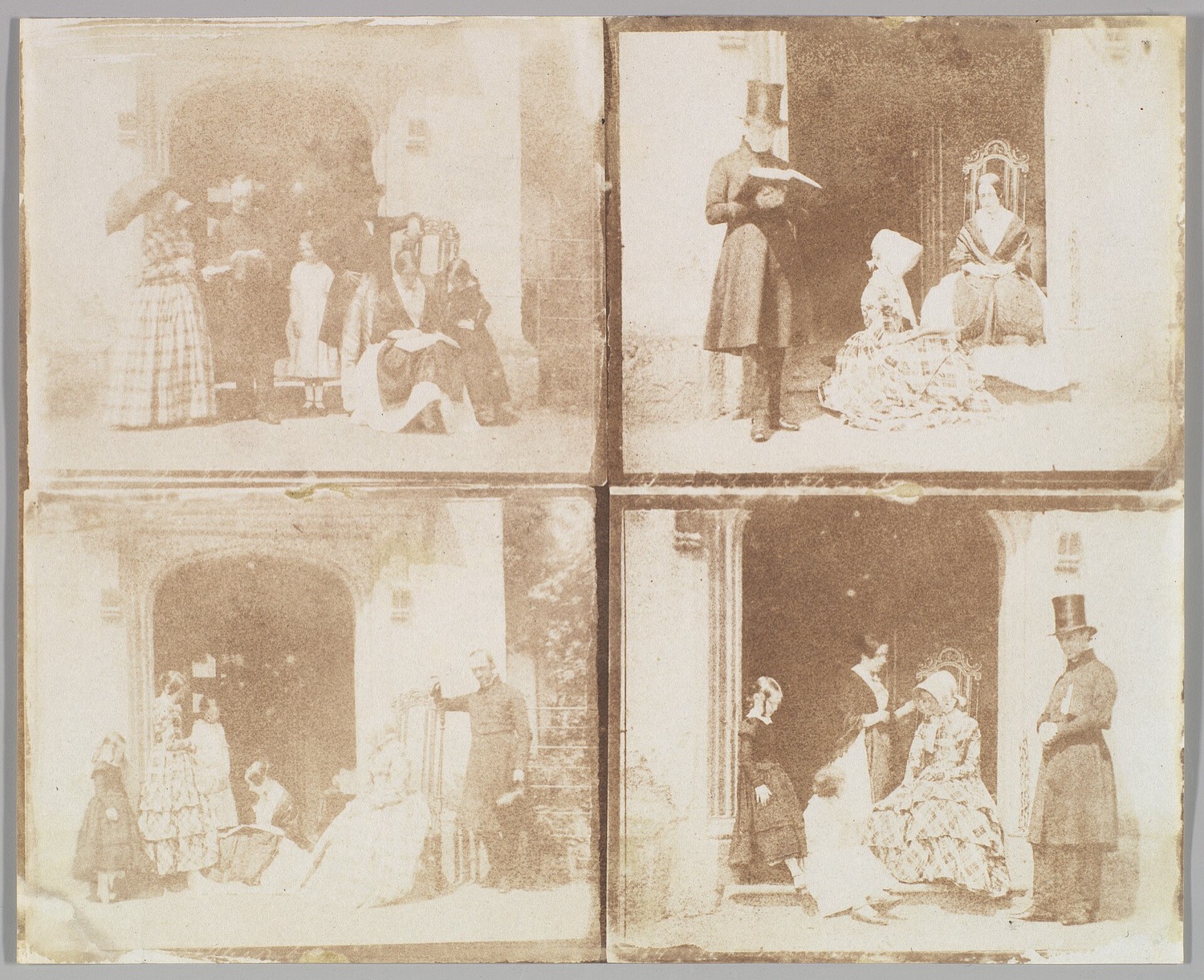
Calvert Richard Jones, four views of a group in a doorway, around 1850. Salted paper print from a paper negative. By Calvert Richard Jones, CC0. Source

Jones's sheet dates to around 1850. Four views of the group in the doorway appear on a single print. It is a different arrangement from the later contact sheets made from strips of 35 mm film.
Before the roll
In photography's early decades, negatives were often made on paper. To make a print, the negative was laid on light-sensitive paper and exposed. There was no enlarger; the image kept the size of the negative.
That is where the term contact print comes from: the negative and light-sensitive paper touched. The print kept the size of the negative. Jones's sheet holds four views on one print.
Later, as 35 mm film became common, many frames from one roll could be arranged on a single sheet. The printing method stayed the same. Photographers could now compare several frames side by side.
Who chooses?
On 7 October 1971 Oliver F. Atkins, Nixon's chief White House photographer, photographed Charles Colson, special counsel to the president. The sheet holds about thirty portraits: Colson with a hand at his chin, without it, in glasses and in profile. The poses repeat with small changes. Along the right edge is a typed strip: Portrait studies--Charles W. Colson, Special Counsel to the President, 10-7-71, 7454, LIBRARY. There are also handwritten marks, brackets and numbers on the frames.
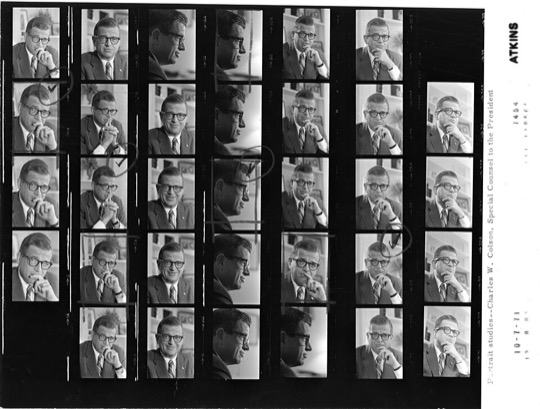
Oliver F. Atkins, contact sheet from the portrait session with Charles Colson, the White House, 7 October 1971. Handwritten marks and brackets appear on the frames. By Oliver F. Atkins, public domain. Source

The sheet holds about thirty attempts at one portrait. They differ in small ways: a hand at the chin, the angle of a head, a glance. A single print hides those variations. Here they remain together.
The margin records the session, Colson's name and title, the date and the roll number. Marks appear on several frames, but the sheet does not say who made them or whether they show a final choice.
We cannot tell whether these marks record a selection, a working note or something else. We can see that someone continued to work on the sheet after the photographs were made: writing, numbering, grouping frames. The finished print does not show that stage.
One photograph among many
During his trip across the United States, Robert Frank shot 767 rolls of film. Later, 83 photographs appeared in The Americans. The numbers give a sense of the work's scale, but not of how Frank arrived at each image. The contact sheets preserve part of that process: similar frames and small differences between them.
When a sheet goes on the wall
Magnum Contact Sheets, edited by Kristen Lubben, brings together 139 sheets by 69 photographers. Material once used to select and organize photographs became part of a public account of how those photographs were made.
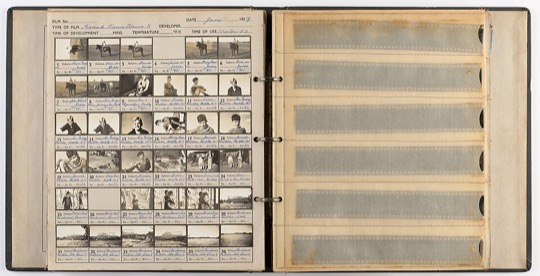
An album page by Marcia A.M. Clark: 36 numbered prints with handwritten captions; beside them, strips of negatives in sleeves. Bendemere, New South Wales, June 1939. By Marcia A.M. Clark, public domain. Source

The 1939 page shows a sheet in its working surroundings. Strips of negatives sit beside the print, all bound in an album. Someone wrote in the film number, date and developer. Those fields tell us more about the archive than a later artwork label would.
In a gallery, we look at the sheet differently. Enlarged, framed and captioned, it is no longer a working aid. The sequence is still visible, but the sheet itself has become an image on a wall.
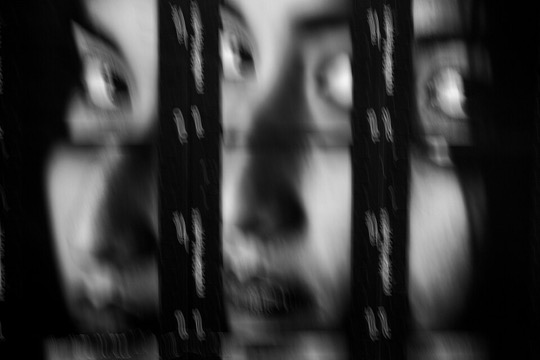
Alexandre Dulaunoy, a portrait assembled from contact print frames and photographed with intentional camera movement. By Alexandre Dulaunoy, CC BY-SA 2.0. Source

In Alexandre Dulaunoy's work, the arrangement of frames becomes part of the composition. The prints do not lead to one chosen portrait; together, they make the image.
Unseen frames
Garry Winogrand died in 1984. He left about 2,500 undeveloped rolls and 300,000 unedited photographs. The film was developed after his death. John Szarkowski, Tod Papageorge and Thomas Roma selected photographs for MoMA's 1988 exhibition.
Making a contact sheet requires someone to sit down and look through the frames. Without that, it is a record of possibilities, not a choice. In Winogrand's case, some of the decisions were made by people who encountered his photographs only after his death. It is hard to tell whether this continued his work or became work on someone else's archive.
It is easy to collect thousands of photographs on a phone and put off choosing among them. Perhaps that is why contact sheets still hold our attention: the decision leaves a mark, and the sequence does not disappear behind one finished frame.
The grid on a screen
Thumbnails on a screen resemble a contact sheet. They let us compare frames quickly and pick one. But behind a digital grid there is no sheet to label, file away and find years later. There are files, folder names, copies in several places. Is making a choice enough to make an archive?
When we look at someone else's contact sheet, we sometimes try to pick the photograph before the photographer does. Sometimes we mark the same one. Perhaps the more interesting part is that for a moment we can be wrong, without knowing which frame survived.
Further Reading
- Magnum Contact Sheets, Thames & Hudson - one hundred and thirty-nine sheets by sixty-nine photographers
- Robert Frank's trip across the United States, National Gallery of Art - 767 rolls and the project that led to The Americans
- Looking In: Robert Frank's The Americans, National Gallery of Art - exhibition with 28 contact sheets and all 83 photographs from the book
- Garry Winogrand, MoMA - collection and biography
- Garry Winogrand exhibition, MoMA, 1988 - notes on posthumous processing and selection
- Calvert Richard Jones at The Met - the sheet of four portraits, c. 1850
- Roll WHPO-7454, Nixon Library - Charles Colson portraits from 7 October 1971
Co-created by human and AI.