Some links on this site may be affiliate links.
Photography as Haiku
A photograph by Masao Yamamoto is the size of a postage stamp. A bird against a pale gray sky. A fragment of a nude body. A leaf. Nothing more. Yamamoto dyes his prints in tea, tears their edges, paints over them, exhibits them loose like pebbles collected on a walk. Each of these images weighs less than a word. Yet it holds your gaze longer than any billboard.
Seventeen syllables. An old pond. A frog jumps. The sound of water. This is the most famous haiku by Matsuo Basho. Three lines that freeze a moment as precisely as a camera shutter. Silence. Then movement. A splash. Then silence again.
There is something here that goes beyond accidental similarity.
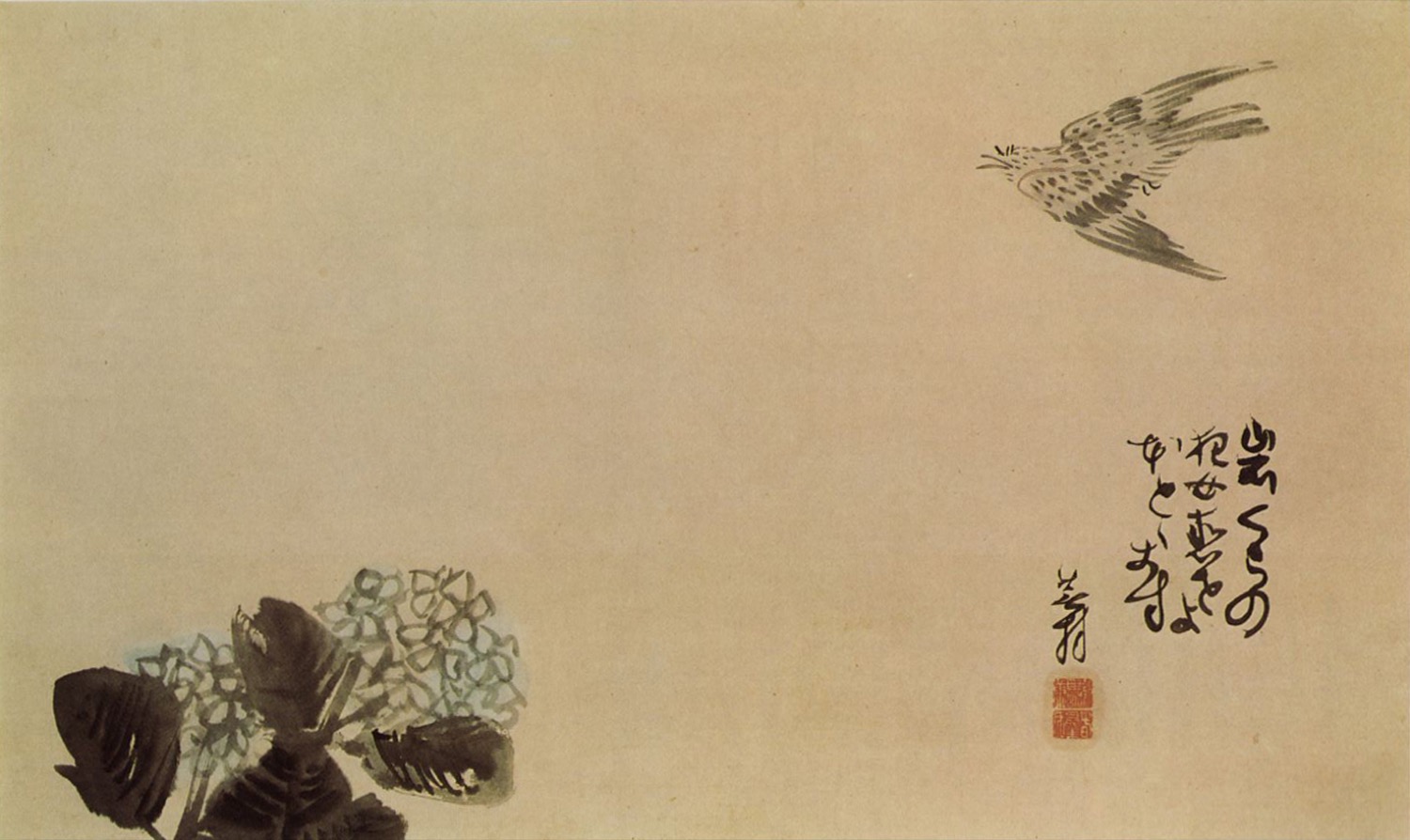
Cuckoo and hydrangea. Yosa Buson (1716-1784), haiga - a traditional fusion of haiku with ink painting. Public domain. Wikimedia Commons
_by_Yosa_Buson.jpg)
Seventeen Syllables
Haiku is not a poem about nature. It is the record of a moment when reality cracks open and for an instant you see something more through the gap. The 5-7-5 syllable structure is merely a technical scaffold. The real content lives in what was not written.
Three classic examples:
Basho:
An old pond a frog jumps the sound of water
Buson:
Spring departing birds cry fish have tears in their eyes
Issa:
Snail slowly climb Mount Fuji but slowly
Each of these poems carries the same tension. Something happens, yet what matters most happens outside the words. Between the lines. In the silence that falls after reading.
In haiku there is a concept called kireji - the cutting word. A word that splits the poem into two parts, forcing the reader to connect them independently. The reader becomes a co-creator.
Even formally, haiku is like a photograph: a single moment frozen, ripped from context, presented alone, without explanation.
A Box of Emptiness
Masao Yamamoto, born in Japan in 1957, started as a painter. When he picked up a camera, he made photographs that feel more like paintings than what the West usually understands as photography. His prints are small - the size of your palm, sometimes smaller. He dyes them in tea to age the paper. He tears their edges. He paints on them with ink, adding elements the lens never recorded.
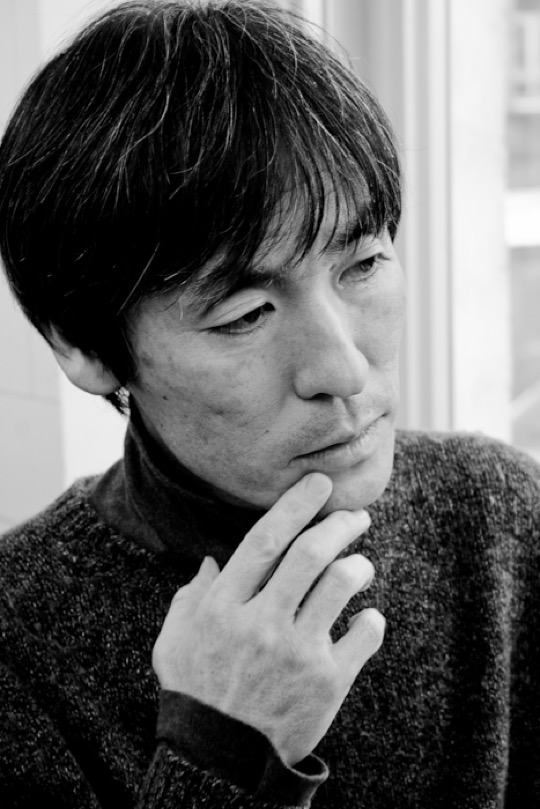
Masao Yamamoto at Pobeda gallery in Moscow, 2009. Author: UzVer kms, public domain. Wikimedia Commons

His most celebrated photobook is titled A Box of Ku. In Japanese, ku means "emptiness" - not as nothingness, but as potential, the space in which something can exist. Ku is also the second syllable of haiku. By naming his book "a box of emptiness," Yamamoto makes a gesture that ties both traditions together: photography and poetry.
His photographs are like individual haiku verses. A bird against the sky. A nude woman in darkness. A leaf on the ground. A mountain in mist. Each image is a fragment that implies a whole. Looking at them, you feel that what you see is only part of something larger - like a single verse torn from a longer poem.
Yamamoto exhibits his small prints loose on walls, sometimes arranged in installations that resemble scattered words. Viewers can look at them in any order, compose their own sequences. Every viewer becomes a reader - or rather: a co-author of the poem.
Color as Poetry
At the same time, on the other side of the world, Saul Leiter was photographing New York.
Leiter, an American who was meant to become a rabbi but became a photographer instead, spent two decades making images that defied everything street photography considered important. He did not search for the decisive moment. He did not tell stories. He registered impressions: a red umbrella reflected in wet asphalt, someone's face behind a fogged bus window, a patch of light on a wall.
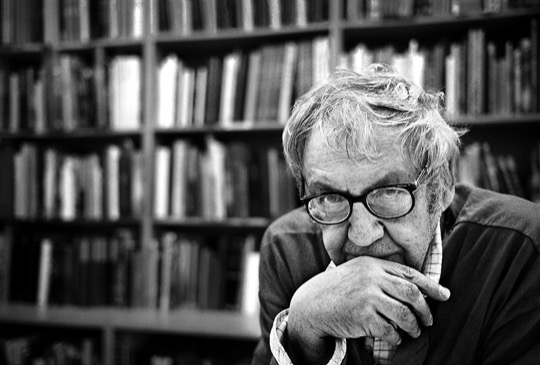
Saul Leiter, 2008. Photograph by Pierre Belhassen, CC BY-SA 3.0. Wikimedia Commons

Where other photographers sought strong compositions, Leiter found poetry in accident: in reflections, in half-light, in what usually escapes attention. His frames do not close the world into a logical whole. They suggest that something exists beyond the border - and it is precisely that something that matters most.
"I don't know if these are good photographs," Leiter said in an interview. "I just look at things I find beautiful."
This is exactly the haiku stance: to see beauty in the ordinary. A classic haiku needs no grand subject. Old pond. Frog. Splash. That is enough. Leiter needs no grand event. Wet window. Red umbrella. Shadow. That is enough.
The Cut and the Frame
The deepest similarity between photography and haiku lies not in what they show, but in what they leave out.
In haiku, kireji is the cut. In Japanese, this is often an exclamation, a particle, or a specific verb ending - a word that splits the poem into two parts. The reader must find the connection. The cut separates, but also connects. It creates the space where meaning is born.
In photography, the equivalent of kireji is the frame. The line that says: this, not that. The photographer cuts a piece of reality and asks the viewer to complete the rest. The frame is a cut in spacetime.
A good photographer, like a good haiku poet, knows what to omit. What is not in the frame is often more important than what is. Emptiness in composition, absence in the frame, silence after reading - these are all the same phenomenon. Economy as a tool that forces the viewer into active participation.
Ma, the Space Between
Japanese aesthetics has a concept that may be the key to understanding both arts: ma (間). The word means interval, gap, pause - but not emptiness. Ma is charged silence. In music, it is the rest without which sound has no meaning. In a Zen garden, it is the space between stones that turns them into a composition. In haiku, it is the silence after the final verse. In photography, it is the negative space that gives shape to what is visible.
Yamamoto knows this better than anyone. His small photographs are surrounded by white - white frame, white paper, white wall. Each image is an island in an ocean of white. That white is not a background. It is an active part of the image.
Leiter understood this too. His best photographs are those in which the main subject is light and the space between objects. Glass, fog, steam, rain - everything that both blocks space and creates it.
Trust in the Reader
Both haiku and photography demand a certain kind of trust from the viewer. That a fragment can be a whole. That absence is a value. That silence says more than noise.
Basho does not explain his pond. He does not describe the frog. He does not explain why the splash matters. He simply records it. The rest he leaves to the reader.
Yamamoto does not explain his bird. He does not say why he took that particular photograph. He simply makes it, dyes it in tea, tears its edges, and places it on a table. The rest he leaves to the viewer.
In a world where everything is over-explained, processed, captioned, and interpreted, haiku and Yamamoto's photographs can teach something counterintuitive: that less is more. That the most important part of an image - and of a poem - exists where it is absent.
Perhaps the most important lesson photography can take from haiku is this: to see more, you must learn to say less.
Further Reading
- Masao Yamamoto, Small Things in Silence (RM, 2014) - book on publisher's site
- Masao Yamamoto, A Box of Ku (Nazraeli Press, 1998)
- Saul Leiter, Early Color (Steidl, 2006) - book on publisher's site
- Matsuo Basho, The Narrow Road to the Deep North (various English editions)
- R.H. Blyth, Haiku (4 volumes, Hokuseido Press)
- Masao Yamamoto: official website
- Saul Leiter: Saul Leiter Foundation
Co-created by human and AI.