Some links on this site may be affiliate links.
The Authenticity Paradox
I am looking at a portrait. A woman's face emerges from what seems like darkness, lit by hard light. The skin has texture: wrinkles around the eyes, furrows on the forehead. This is a face of a woman who has seen much. That has lived. If I met her on the street, I would swear we knew each other - that I had seen that look somewhere before...
I have not met her. She does not exist.
The portrait I am looking at was created in a process whose description reads like a confession: Created using experiments with AI then Lightroom. Inspired by Anton Corbijn Miles Davis portrait (1985). Artificial intelligence generated the facial features, but it was the human - a creator - who gave them mood, light, atmosphere. Together they created someone who looks more authentic than many documentary photographs. In this single image lies the entire paradox of visual culture of our time.
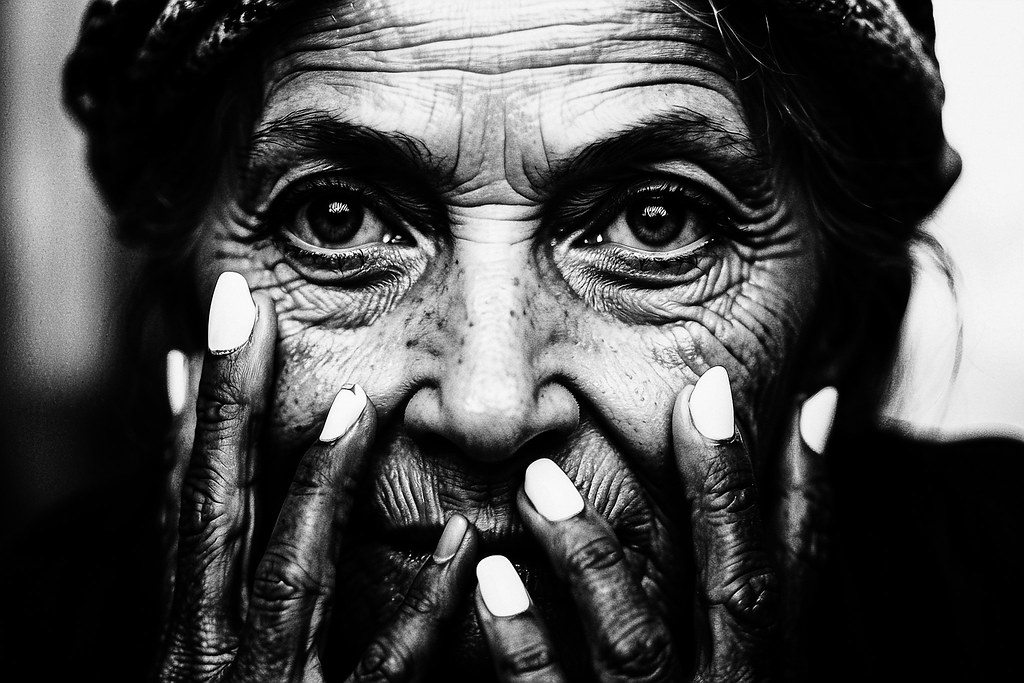
Portrait inspired by Anton Corbijn's photograph of Miles Davis (1985). Author: Mariusz Nawrocki, License CC BY-ND 4.0. Source
The year 2026 has brought photography something seemingly contradictory: a hunger for authenticity. Stock photography trends are dominated by the age-positive movement -- faces with history, with character, with visible traces of life. Wrinkles are no longer a defect to be removed in Photoshop, but a desirable attribute. Gray hair, sun-spotted skin, hands with prominent veins - these are gaining value. Platforms like Envato report an 11% increase in searches for "unfiltered" in the past month alone. Consumers, tired of the smooth, perfect AI-generated imagery, are demanding something real. And here comes the irony that stings.
AI delivers authenticity
The latest generative models can create a photorealistic portrait of an elderly person with such precision that even experts struggle to distinguish it from a real photograph. A study published in Nature in June 2026 revealed that hyper-realistic AI-generated faces trigger different neural signatures in the brain than real ones -- even when we cannot consciously tell them apart. Something in us knows. Something feels the difference. But we cannot name it.
Even more unsettling are the findings published in Perception: generative faces were rated 7.7% more trustworthy than real human faces. A synthetic countenance appears more credible to us than a living person's face. Add to this the 2025 MIT experiment in which 60% of participants mistook a human for a chatbot (and vice versa), and a picture emerges of a reality where the boundary between authentic and generated is not so much blurred as it has simply ceased to have perceptual meaning.
This is not the first time technology has interfered with our sense of authenticity.
Nineteenth-century studio photography was, in essence, the first "artificial authenticity" - painted backdrops, forced poses, exposures lasting minutes. Retouching in the analog film era was standard: Ansel Adams spent hours in the darkroom manipulating contrast and sharpness. Hollywood has been digitally de-aging actors for decades, and Instagram has programmed us to accept "strategic vulnerability" - selfies with perfect lighting and artistically rumpled sheets meant to pass as accidental snapshots.
Every era has its technology
It is AI that breaks this relationship in a fundamental way. Earlier tools - from the brush to Photoshop - required a human hand to provide direction and intention. AI, on the other hand, is the first visual technology that can generate images without direct human participation. The problem is not that AI creates images - but that it creates them so well that we cannot distinguish them from reality.
A study published on arXiv in March 2026 (Human Factors in Detecting AI-Generated Portraits) involved 1,664 participants aged 20-69. Overall accuracy in distinguishing AI from real faces was 85.2%. A seemingly high result - but with a clause that gives pause: mobile device users performed worse than PC users, older participants worse than younger ones, and women over fifty - worst of all. In other words, our ability to detect a synthetic face depends not on the image itself, but on who is viewing it, on what device, and at what age.
Authenticity is not a property of the image. It is a relationship between the image and the viewer.
And this brings us to the heart of the paradox. If an AI portrait triggers an authentic emotion in us - emotion, admiration, curiosity - does it matter that the person portrayed does not exist?
Virtual influencers like Lil Miquela and Aitana Lopez have more followers than most living models. Research on virtual influencers (Ju, Kim & Im, 2024) shows that the perceived authenticity of these digital entities depends not on their material existence, but on the coherence of their narrative and their relationship with the viewer. In other words: if we tell a story well enough, the fact that the main character is made of pixels ceases to matter.
This does not mean everything is permitted. Research on the uncanny valley - the phenomenon of unease triggered by entities too similar to humans but not similar enough - clearly shows that there is a threshold beyond which we lose the viewer's trust. The problem with AI is not that faces are too perfect - but that they are sometimes too human in a way that has no basis in reality.
Three paths at a crossroads
The first is transparency. If we know that a portrait was generated by AI, we can consciously decide whether we want to enter into a relationship with it. Research on disclosure in virtual influencer communication suggests that openness does not destroy connection - provided the narrative is coherent enough.
The second is hybridity. The process I described at the beginning - AI generates the raw material, the human gives it form - is a model that may prove the most honest. We do not pretend the image was created without technology, but we also do not claim the human had no part in it. Collaboration, not substitution.
The third path is recognizing AI portraits as a separate genre. Not better, not worse - simply different. Just as photography did not kill painting, and cinema did not kill theater, AI-generated images do not kill photography. They can exist alongside it, as separate visual languages with their own criteria of evaluation.
The portrait I began this essay with is, to me, an experiment showing that these three paths are not mutually exclusive. It was created by AI, but declared, narrated and then workshop-crafted by a human. It was inspired by a specific photographer - Anton Corbijn - and his iconic portrait of Miles Davis from 1985. It carries a story, inspiration, craft. It is authentic not because it depicts a real person, but because it is a real act of creation.
Perhaps this is the answer. Authenticity does not reside in the object, but in the intention. Not in what we see, but in how it was made. Not in the face in the photograph, but in the relationship between the creator, the viewer, and his awareness of the process.
By 2027, the question "is this face real" may lose its meaning. We will learn to ask differently: whose is the intention? why? Is what I feel when looking at the image truly mine - or has it already been programmed?
I do not know the answer. But I know that the portrait I am looking at does not stop looking back at me.
Co-created by human and AI.