Some links on this site may be affiliate links
Can Creative AI Use Revolutionize Fashion Design?
Can Creative AI Use Revolutionize Fashion Design?
I am looking at a photograph. A female silhouette in a tight bodysuit that looks like a second skin. The surface is cracked, dry, resembling the parched earth of a dried-up lake bed. Green shoots emerge from the cracks. The body becomes a landscape. Soil and vegetation in one.
This dress does not exist.
It is not in any store, no tailor has touched it, no model will walk it down any runway. It is an image. Generated by artificial intelligence from a description written by an artist. Then refined in Photoshop and Lightroom. It exists only on a screen.
And it asks a question: is this still fashion?
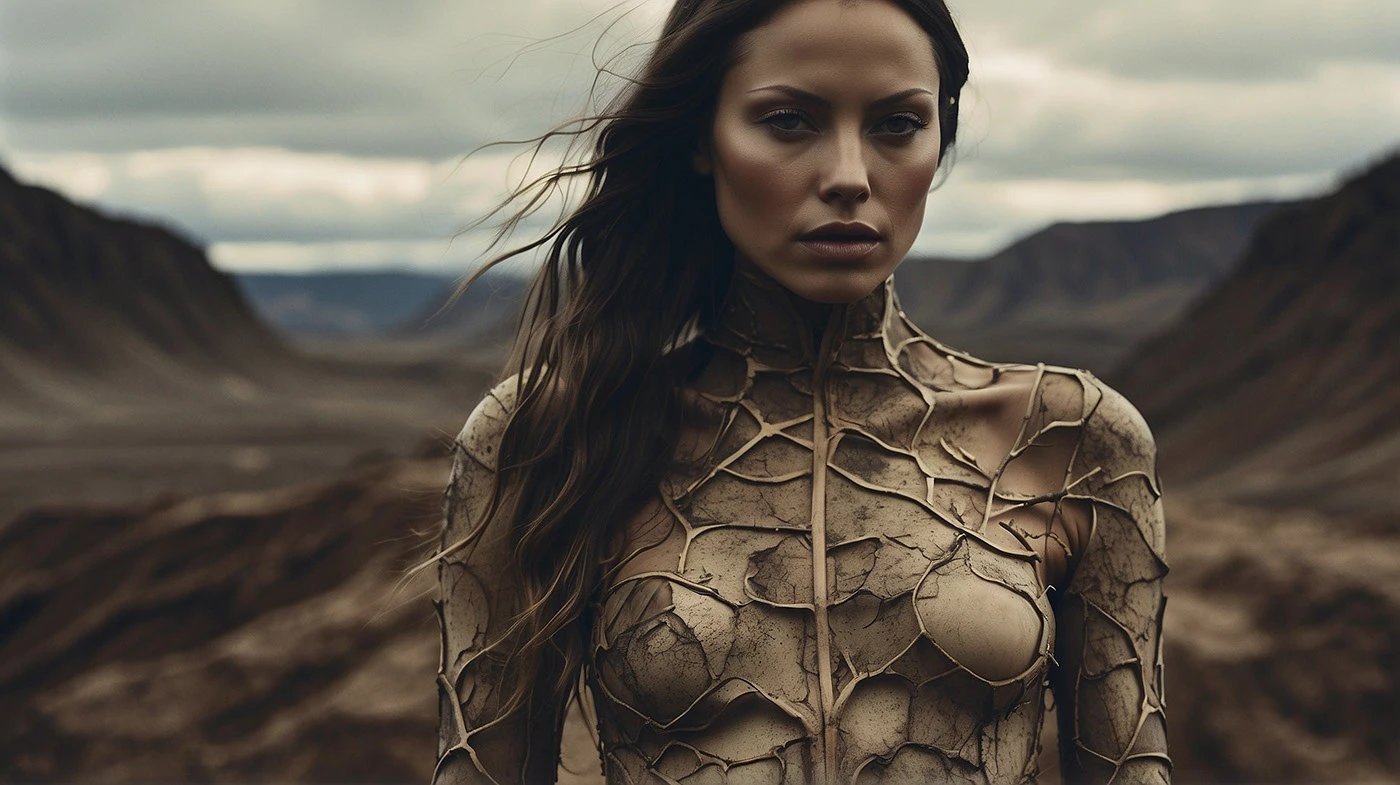
Rooted Reverie - a second-skin bodysuit concept with cracked earth texture and sprouting green shoots. Generative design: Mariusz Nawrocki, CC BY-ND 4.0. Behance
The tailor who is not there
For millennia, fashion design was a craft. The tailor knew the fabric, knew the body, knew the stitch. The cut was born in his fingers. Even in the twentieth century, the greatest - Poiret, Vionnet, Balenciaga - designed directly on the mannequin, draping fabric, pinning, watching how the material fell on a living body.
Then came technology. CAD, 3D printing, smart fabrics. But these were still tools in human hands. The machine did not decide; it suggested.
AI changes this relationship. Suddenly it is not the designer telling the machine "do this," but the machine proposing to the designer "how about this?" And that "how about this" can be surprising. Sometimes better than what the human imagined.
Is this a revolution? Yes. But not in the way we think.
Fashion without matter
Rooted Reverie is a series of images - not clothes. Yet the clothes are there. They can be described: tight bodysuits with cracked earth texture, high necklines, organic lines, green shoots growing from the fabric. This is a fashion collection that exists solely as a vision.
Is this fashion at all?
When a designer sketches a dress on paper, it is not yet a dress. When an architect draws a house, it is not yet a house. But both are designs. Rooted Reverie is a fashion design - executed in a language the tailor does not understand. The language of prompts, semantic weights, and iterative image refinement.
The artist writes: "bodysuit with cracked earth texture, high necklines, organic lines, green shoots growing from the fabric." AI generates an image. The artist selects, rejects, refines, specifies. This is not automation. This is dialogue.
And in this dialogue, something new is born: a fashion design that does not exist in the physical world but is complete in its vision. Is it less than a pencil sketch? Perhaps. Or perhaps something more...
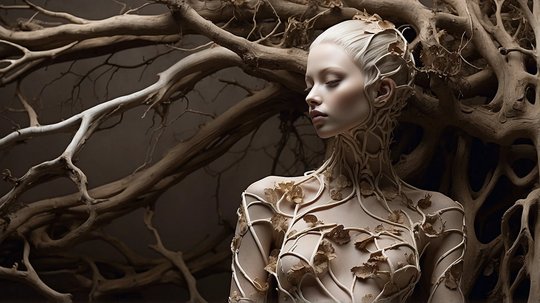
Rooted Reverie - texture detail: cracked earth, green shoots, second skin. Design: Mariusz Nawrocki, CC BY-ND 4.0. Behance
Two collections, one method
Rooted Reverie and EPHEMERA are different projects, connected by method. Both emerged from the same process: the creator formulates a vision, AI generates images, the creator selects and uses them. The essence lies in what happens after choosing specific artifacts - this is where the creative element buds, often leading to further AI iterations, with each project arriving at a different final result.
Rooted Reverie is organic, heavy, earthy. The body merges with the soil. It recalls the sculptures of Giuseppe Penone, who grows trees through art galleries. It is about endurance, decay, and renewal. Rootedness.
EPHEMERA is the opposite. Light, transparent, openwork structures resembling spiderwebs or cracking shells. Mannequins in a store window, dressed in something almost invisible. This project is about ephemerality, about the seasonality of fashion, about the fact that before a dress reaches the hanger, it is already obsolete.
Two sides of the same coin. Both created without a single cut of scissors.
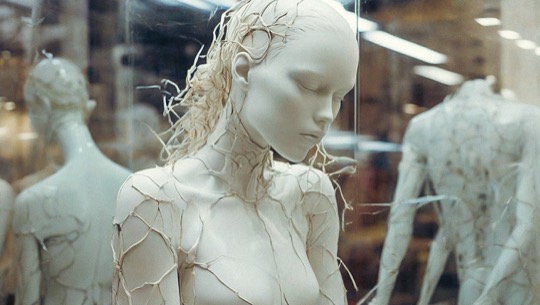
EPHEMERA - storefront concept with mannequins in transparent, web-like structures. Design: Mariusz Nawrocki, CC BY-ND 4.0. Behance
The new craft
In traditional fashion design, the workshop was visible. The stitch, the texture, the way materials joined - these testified to craftsmanship. With AI, the workshop is invisible. A prompt has no grain, no texture, no temperature.
But this does not mean it does not exist. Only that it looks different.
The new craft is the ability to formulate a vision. It is the capacity to foresee what the machine will generate before seeing it. It is iteration: generate, evaluate, refine, generate again. It is the patience to sift through hundreds of images to find the one right one.
And this is precisely craft. Different from before, but no less demanding.
Photographers who spent years learning light and frame suddenly discover that their ability to see is more valuable than their ability to operate a camera. Graphic designers discover that composition, color, and mood are things a machine cannot replace - because it does not know what it wants to say.
And perhaps this is the essence: AI does not take work from artists. It takes work from those who confuse technical skills with visual sensitivity.
Ephemerality and permanence
Fashion is by definition ephemeral. Seasons pass, collections become outdated. What was fashionable last year is passé today. AI has amplified this ephemerality: now you can generate an entire collection in a day, and the next day forget about it and make a new one.
But there is a paradox here too. An AI-generated image is more permanent than a physical dress. The dress deteriorates, fades, goes out of style. The image remains. It can be viewed a hundred years from now, just as today. The immaterial proves more durable than matter.
EPHEMERA speaks of this directly: transparent mannequins, structures like spiderwebs, something that is barely there. And this "barely" is the most interesting part - because the boundary between existence and non-existence in AI fashion is fluid. The dress exists as an image but does not exist as an object. It is and it is not. Like Schrödinger's cat, only made of fabric.
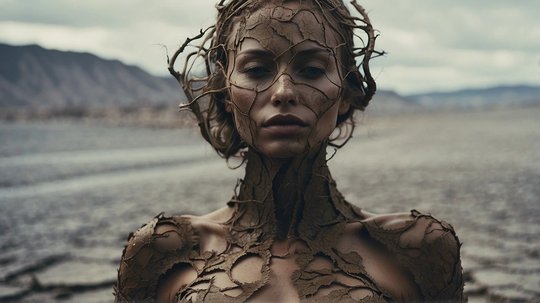
Rooted Reverie - organic second-skin bodysuit, greenery emerging from texture. Design: Mariusz Nawrocki, CC BY-ND 4.0. Behance
Designer or curator?
As more elements of the creative process are taken over by the machine, the role of the designer changes. From creator to curator.
This is not new. Since Duchamp's readymades, artists have been curators of reality. They point to what is art and what is not. In fashion design, this shift is only now taking place. The designer no longer needs to sew, cut, or even draw. They need to know what they want to say. And they need to recognize when the machine has generated something worth keeping.
This requires sensitivity. And this sensitivity - not the ability to operate a tool - will be what distinguishes the artist from the user in the AI era.
Rooted Reverie would not exist if the artist did not know what cracked earth on skin should look like. EPHEMERA would not exist if he did not understand what ephemerality means in fashion. AI generated the images, but the vision belonged to the human.
And this, I think, is the point. AI does not invent. It proposes. The human chooses. And that choice is the creative act.
Instead of a conclusion
I return to the photograph from the beginning. The woman with cracked skin from which greenery grows. I know this is not a real body. I know this is not a real dress. And yet I look and think: I would like to see this in real life. I would like to touch that texture.
Perhaps this is the answer. AI fashion will not replace physical fashion. It will not replace the touch of fabric, the cut of scissors, the smell of a new dress. But it can be its extension. A laboratory of the imagination where ideas can be tested before they reach the runway. And where some ideas will remain only images - and that is all right too.
Because not every dress needs to be sewn. Some only need to be imagined.
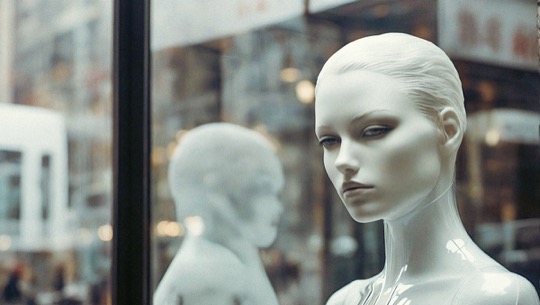
EPHEMERA - openwork, web-like structure on a mannequin, symbolizing fashion's ephemerality. Design: Mariusz Nawrocki, CC BY-ND 4.0. Behance
Further reading
- Rooted Reverie on Behance - project
- EPHEMERA on Behance - project
- Iris van Herpen official site - fashion and technology
- Fashion and technology books on Amazon
Co-created by human and AI.